Benefits of social media for social marketing, PR, and insights
Discover the most powerful benefits of social listening and learn how to improve your reputation, customer experience, product development, and more.
September 10, 2025
People are talking about you on social networks, in forums, on review sites, and all across the internet. A good social listening program ensures you hear what they have to say.
Social listening is the practice of monitoring online discussions for mentions of:
your brand,
your industry,
your competitors,
or any other topic that could guide your strategy.
There's a vast amount of unstructured data out there. Running it through powerful analysis tools gives you actionable insights into the public perception of your brand.
Social listening is much more than a marketing buzzword. It’s a vital strategic function. It can impact just about every team within your organization, from front-line customer service to social media management to R&D.
14 key benefits of social listening
1. Uncover audience insights
Understanding what your audience wants from you, and how they feel about your brand in real time, is probably the most familiar benefit of social media monitoring. A deeper connection with your audience can drive almost every aspect of your business strategy. But it’s especially useful for guiding your social media strategy.
For example, an NBA team used Talkwalker to analyze engagement and social sentiment. They wanted to get a better understanding of what fans wanted from the team’s social channels. They found that the audience wanted more interactive content, like polls and Q&As. And they wanted a bolder, more authentic tone from the team’s online presence.
The team switched up its social efforts. They put aside broadcast clips and league-approved footage. Instead, they created an original content strategy. They shared insider content and behind-the-scenes footage in their social media posts. The change in strategy led to a 46% increase in impressions and 352% increase in video views.
2. Flag trends early
A good social listening program helps you pick up on subtle shifts in sentiment, language, and even emojis. It's a good way to identify trends as they start to emerge. This allows you to keep your content and brand voice relevant without looking like you’re chasing trends too late.
For example, the beauty brand Yves Rocher noticed a shift in the online conversation about beauty. Claims about reducing wrinkles and shrinking waistlines evolved into discussion about health, self-care, and natural beauty.
At the same time, social listening showed a shift toward more inclusive expectations. Consumers expect beauty brands to serve all ages, skin tones, and genders.
Understanding this trend as it emerged allowed Yves Rocher to stay ahead of the curve and continue to meet customer expectations.
3. Manage brand reputation
Social listening keeps you aware of the full conversation about your brand online. You can also keep an eye on customer sentiment about your brand in real time. The ability to identify both negative and positive feedback as it happens helps you protect your brand reputation. Even during difficult moments.
For example, when the Bayes Business School underwent a controversial renaming, they knew not everyone would be happy. It was critical to monitor the online conversation and look for brand reputation risks. (The school was renamed after the original namesake was found to have links to the slave trade.)
During the renaming process, they looked for positive content to amplify. They also flagged and corrected misinformation as it arose. This is a particularly useful reputation management strategy during moments of change. The school can use it again as they roll out changes to their MBA program.
Social listening can also help you identify and correct any reputation gaps. These are differences between how you see your brand and how your audience perceives you. When you identify a mismatch in perceptions or expectations, you can use data and insights extracted from social listening to…
4. Refine brand messaging and positioning
Your customers are telling you what they want from your brand online. Social listening makes sure you hear what they are saying.
For deep insights, look beyond simple compliments and complaints. Look for emotional cues like pride, nostalgia, and anxiety. These can help you tap into deeper motivations than a new feature set.
Social listening also helps you understand how your brand fits into larger cultural conversations, key moments, and existing niche communities. This helps you position your brand in ways that feel natural and timely, rather than cringey and opportunistic.
5. Improve customer service and loyalty
A good social media listening tool ensures you capture all online customer feedback. That includes social media, forums, review sites, and other online platforms. This empowers your customer support team to respond to questions, complaints, and compliments as they arise. It improves response time and customer satisfaction.
Ongoing brand monitoring also helps you identify recurring questions and concerns. If they’re easily addressed, this could prompt new blog content, FAQs, or online resources to help people better understand how to use your products or services.
If you identify ongoing pain points or service gaps, you might need to take things a level further. Loop in the tech support or product development teams to optimize the customer experience long-term. On that note…
6. Inform product development and innovation
Social listening provides a vast amount of data and insights about unmet customer needs, customer suggestions and requests, and new customer behaviors. Monitoring public interest and sentiment around your own and similar brands and topics can also help validate ideas and refine your product concepts.
For example, Dubai TV Channels set up live data dashboards and alerts in Talkwalker to monitor audience response to their shows after each episode aired. This gave the target audience a voice in creating shows. The channels’ management team used the audience data collection to guide decision-making about which shows would continue production.
7. Spot emerging customer segments
Advanced social listening tools like Talkwalker use AI to analyze patterns in conversation and audience data. This can help you identify segments you're not yet targeting based on shared demographics, interests, motivations, and behaviors.
It can also help you spot newly emerging interest groups or communities as they arise. Analyzing who’s participating in these new communities and what topics are gaining traction in their conversations helps you identify potential customer groups before the competition.
In this context, there will likely also be new influencers leading the conversation. Micro-influencers may have outsized impact here, making influencer marketing campaigns more budget-friendly. Which leads us to…
8. Find potential collaborators and partners
Social listening helps you find the people and brands leading the conversation in your industry. The right tools help you analyze their engagement levels, reach, share of voice, and audience demographics. You can identify the accounts that have the most potential to connect with your audience without a competitive conflict.
When you spot a potential collaborator, run a sentiment analysis to understand how their content is perceived. This ensures you partner with positive voices that will enhance your brand reputation.
9. Conduct competitive analysis
Just like you can look at potential collaborators, you can also use social listening to get a thorough picture of what your competition is up to. Competitive benchmarking helps you understand the state of your industry. It allows you to set clear, strategic goals to improve your place within it.
Social listening also keeps you informed of your competition’s latest moves as they happen. Examples include new campaigns, product releases, and media coverage.
10. Proactively manage crises
Social listening is an early warning system for emerging brand crises.
For example, social listening alerts first made Hong Kong Airlines aware that one of their flights was mispriced. It was listed at just $561 for business class from Los Angeles to Shanghai. They realized they needed to address the issue quickly. But they took a moment to analyze how other airlines had fared in similar situations. They used social listening to see that British Airways had taken a significant hit to its reputation for deciding not to honor a similar misprice.
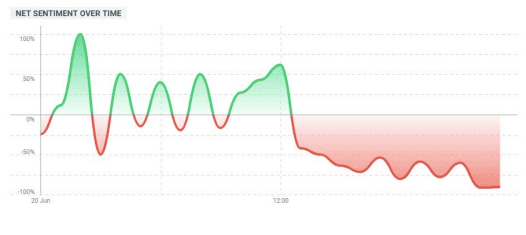
British Airways' sentiment after refusing to honor an error fare (Source)
The early warning allowed Hong Kong Airlines to correct the price immediately. Meanwhile, the competitive research helped guide their decision to honor the price for those who had already bought the fare. All of this happened within 24 hours of the issue arising.
Brand sentiment remained positive, while mentions of the airline increased 268.1% in the U.S.
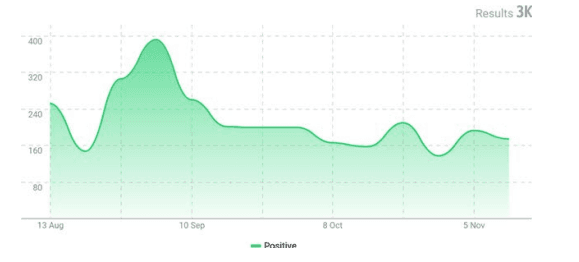
Hong Kong Airlines' sentiment after correcting (but honoring) the error fare (Source)
11. Identify product hacks and unintended uses
Your brand might not have a hashtag as obvious as #Ikeahacks. But your customers may still be using your products and services in ways you don’t expect.
Social listening ensures you capture brand mentions where you are not tagged. That means you get an inside look at content where the user wasn’t specifically trying to get your attention. Like, for example, posts in niche communities about unconventional product use.
This could spark ideas for a new social media marketing strategy. It can also surface opportunities for collaboration, and even drive R&D or product development. (Could you create a version of your product that more closely aligns with these creative uses?)
12. Curate user-generated content
Of course, some people will also be using your products and services in more expected ways. This content is not so useful for strategic planning. But it is very useful for filing out your social content calendar and connecting with potential brand ambassadors.
For example, Zoo Zurich used Talkwalker to identify user-generated content in which they were not directly tagged. They proactively engaged with the creators to share their photos in the zoo’s own Instagram feed. They now use the hashtag #FollowerFotoDerWoche to share a UGC post every week.
13. Identify use (and misuse) of brand assets
A sophisticated social listening tool like Talkwalker uses AI-enabled image recognition, visual analytics, and video recognition to identify brand assets like logos across social media platforms, news sites, blogs, and online forums.
This means you can spot people who are using your brand name and assets inappropriately. This could include fake accounts, scam promotions, manipulated images, or knockoffs.
Setting up alerts helps you identify and shut down these brand parasites quickly. They won't get the chance to take advantage of your customers or make sales that should be yours.
14. Predict shifts in social expectations or regulations
Regulations don’t emerge from nowhere. Tracking niche policy and issue conversations can help you gauge public opinion. It can also provide clues about potential shifts in regulations or social expectations for brands.
For example, the European temperature-controlled logistics firm STEF used Talkwalker to analyze public perception of urban food delivery in the context of environmental and urban planning issues. They also track relevant conversations about environmental labelling and the environmental impact of food products.
This keeps STEF ahead of any shifts in social expectation and regulations, while fine-tuning its communications with stakeholders.
How to use Talkwalker for social listening
Talkwalker offers several ways to find the social listening data most relevant to your goals.
We’ll first walk you through some highlights of the social listening tools built into Talkwalker. Then we'll show you how to set up a custom dashboard and alerts for ongoing automated social listening.
Quick Search
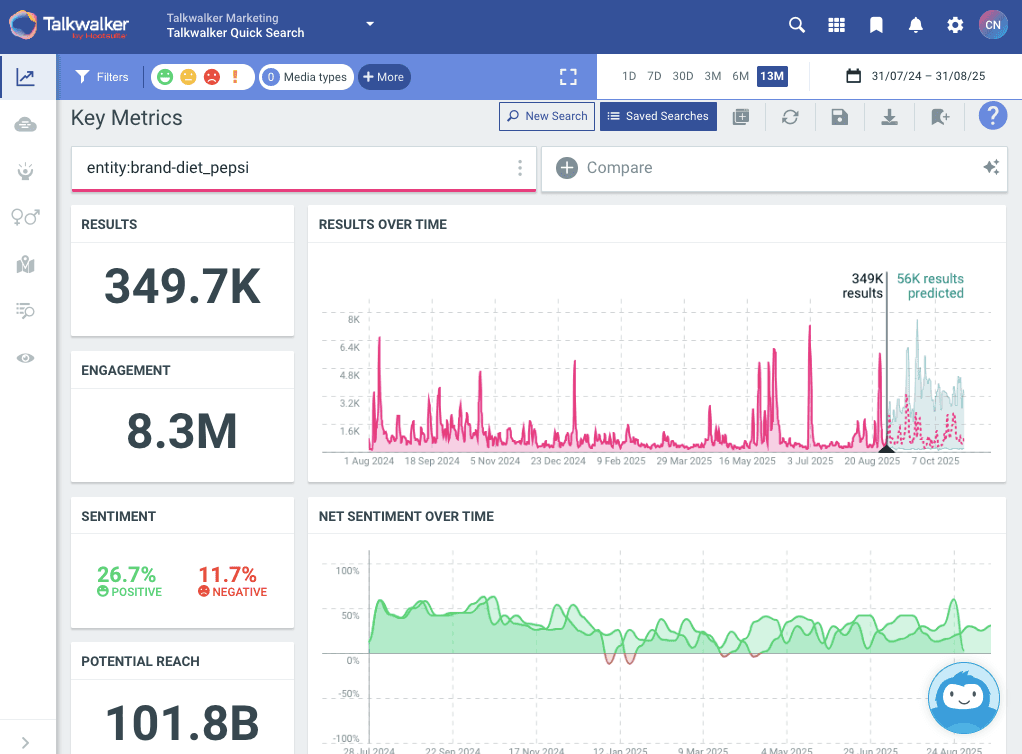
Quick Search is a simple way to get a real-time snapshot of key social listening metrics and valuable insights for any topic or brand. Using Boolean operators or the AI Query Builder, you can create a relevant search for immediate insights.
If you’re new to social listening, it’s an easy place to start. Since it updates results in real time, it’s a good tool to use to refine your search, too. You can tweak your settings until you get exactly the results you’re looking for. (For example, you may need to include more potential misspellings or wildcards to track mentions of your brand.)
Within Quick Search, you can discover metrics like:
Number of mentions
Engagement levels
Sentiment (current and over time)
Potential reach
Top hashtags
Top influencers
You can also click into any chart to drill down for more details and an AI-powered analysis of what’s happening. This functionality applies across the rest of the tools below, too.
Brand Listening IQ App
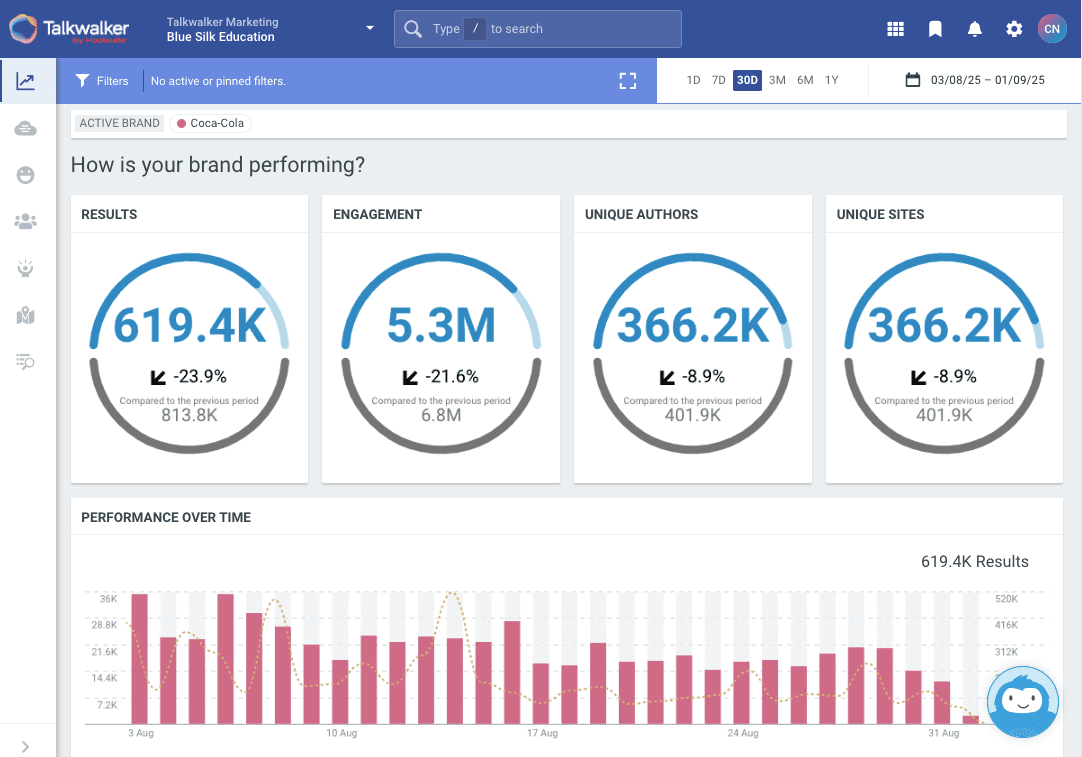
As the name implies, this is the app where you’ll find key social listening data specific to your brand. On each of the tabs, you can find detailed information about your brand’s online footprint:
Themes. Dig into emerging trends, hashtags, themes, and other brands that people associate with your brand
Sentiment. Take a deeper look at how people feel about your brand, and what’s driving those emotions
Audience Analysis. Understand your audience’s characteristics and interests
Influencers. Understand who’s driving the conversation about your brand
Locations. See where in the world the conversation about your brand is happening
Conversations. Look at specific posts and discussions to understand the context behind the mentions
Topic Analytics IQ App
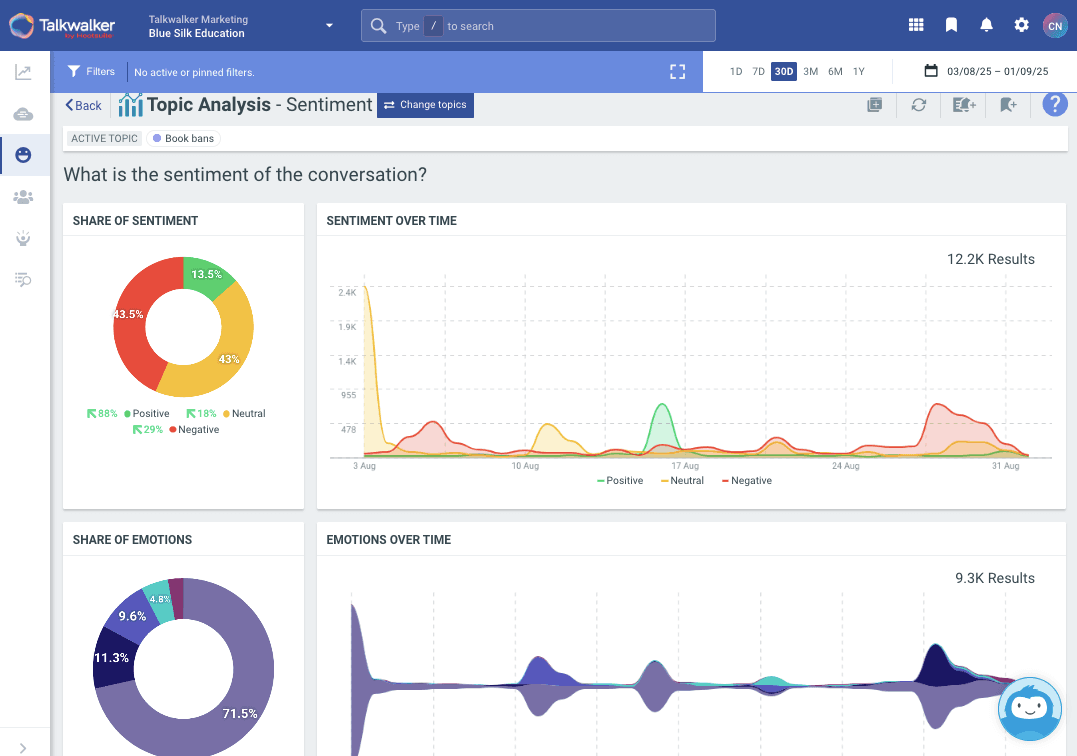
The Topic Analysis IQ App is very similar to the Brand Listening IQ App, and you’ll find many of the same tabs.
However, here you can look into the social media conversations about a topic or keyword, rather than specifically about your brand. You can use this to narrow the conversation, like tracking results for a specific campaign. Or, you can use it to broaden your scope, looking at industry trends.
Influencer Network IQ App
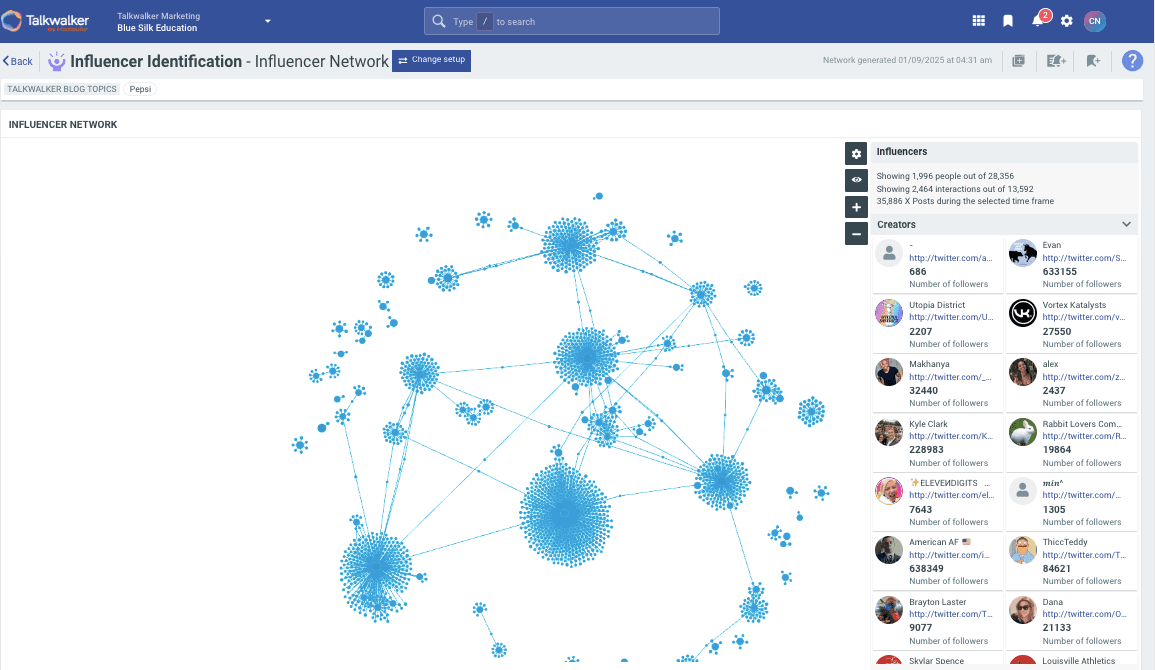
This is a very useful app for understanding who’s leading the conversation about your brand. You can also see how those people are connected with each other.
The visual connections help you identify and analyze the most important influencers for your brand. You can understand their connections and track their interactions.
You can filter your influencer network search to make it as specific as you like. Try filtering based on sentiment to see who’s dominating the positive and negative comments and conversations about your brand.
Crisis IQ App
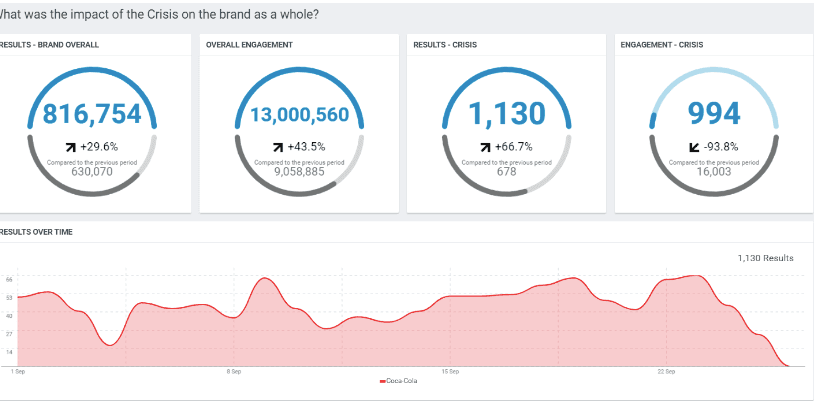
This app is specifically designed for real-time social listening during a brand crisis. You’ll see some tabs that are familiar by now: Audience, Sentiment, and Influencers.
But you’ll also find crisis-management-specific tabs here. The Brand Health tab gives you quick insights into how the crisis is affecting your reputation and your key metrics. The World Map tab helps you understand the spread of conversations, so you can respond quickly and effectively.
You can also see how you have responded to the crisis on your owned social media channels, and how each response impacts the ongoing crisis.
Build a custom dashboard
Each of the tools above contains social listening data useful in different contexts, for different teams. To get the most from your social listening strategy, create a custom Talkwalker dashboard. You can include all the social listening insights necessary for your use case.
Here’s how to do it.
Open one of the IQ Apps described above to use as the starting point for your dashboard. (Don’t worry, you can modify it in a moment!) Click on the Add button in the top menu, then choose Add to dashboard. Name your dashboard, then click Create dashboard.
Open another IQ App to find a metric you want to add to your dashboard. Click the three dots icon. Then click Add to dashboard and select your social listening dashboard. Make any relevant selections and edits in the pop-up, then click Add.
Within your dashboard, you can move the widgets that hold individual metrics around. You can also change their appearance, and divide them into sections. Experiment with your widgets until you have exactly the insights you need in the most useful format for you. You can share your dashboard with the relevant team members so everyone who needs the insights has access.
Alerts
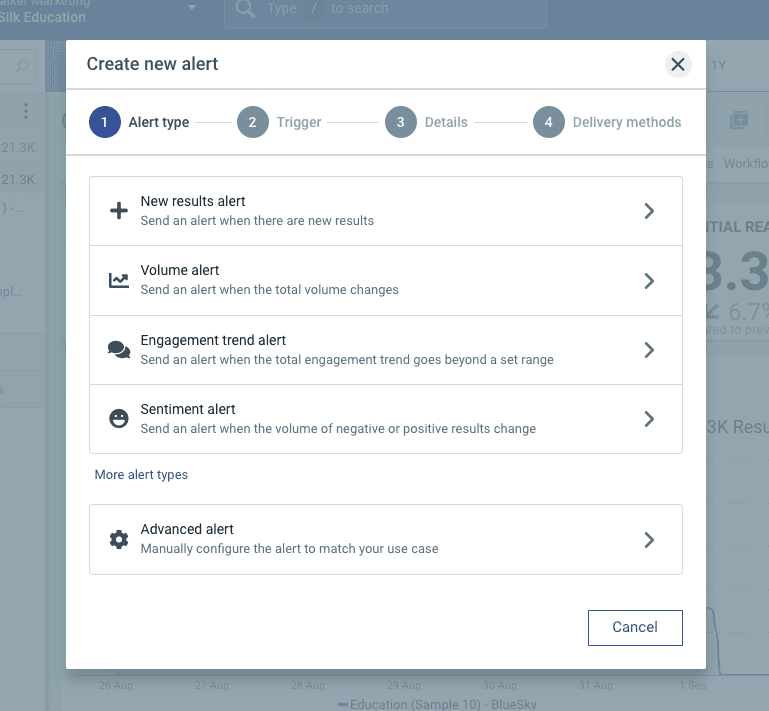
Talkwalker has several pre-configured alert types to notify you when social listening data suggests something might require your attention.
Engagement trend alert. Get a notification if your content sees a spike or dip beyond your expected range. This could indicate an opportunity to double down on content that’s going viral. Or it might signal the need for a quick pivot if things are going off the rails.
Sentiment trend alert. A spike in negative sentiment can serve as an early warning system for an emerging brand crisis.
Issue alert (for online news). Notifies you when online news content could negatively affect your brand.
You can also create custom alerts that combine multiple criteria and filters.
To create an alert, choose any metric from your IQ Apps or dashboards. Click the three dots icon, then Add to report or alert, then Create a new alert.
Choose your alert type. Set the trigger type and conditions, and add any other important details. Then specify who should get the alert.
Listen to online conversations as they’re happening — so you can generate ones that matter. Never miss a thing with the broadest social listening coverage on the market. See Talkwalker in action today.
{{cta('261047136466','justifycenter')}}