Social listening
How to use social search to build visibility and protect your brand
Social media search is the new discovery engine. Learn how to show up across social networks and online forums using advanced tactics and social listening to grow visibility and manage reputation.
February 6, 2026

There was a time that Google rankings were the ultimate prize in search. A top spot for the right keywords was a sure way to connect with everyone looking for what your brand has to offer.
But search behavior is changing. TikTok, Instagram, and Reddit are known discovery engines for Gen Z and younger. But people of all ages are using social search, especially for brand discovery. Nearly three-quarters (72.9%) of people worldwide use social media sites to research brands. A social search strategy is a critical component of any modern online presence and social media marketing plan.
Just to clarify here: People sometimes use the term “social search” to refer to the use of open-source intelligence techniques for finding people and accounts in an investigative context. That’s not what this article is about – we’re focused here on what social search means for brands, marketers, and public relations professionals.
But we do cover OSINT elsewhere on this blog, so if that’s what you’re looking for, head on over to our post on open-source intelligence techniques.
What is social media search?
Social media search is the process of using social media platforms to find information about a topic, idea, or brand. Rather than typing a search query into Google, Bing, or another traditional search engine, the user heads to a social platform and types their keywords into the platform’s search bar.
Is there a social media search engine?
Not exactly. From the consumer perspective, there is no one social media search engine that combs through content on all platforms. Google search results do now include some social results. The forums and short videos tabs in Google are designed to return results from social networks.
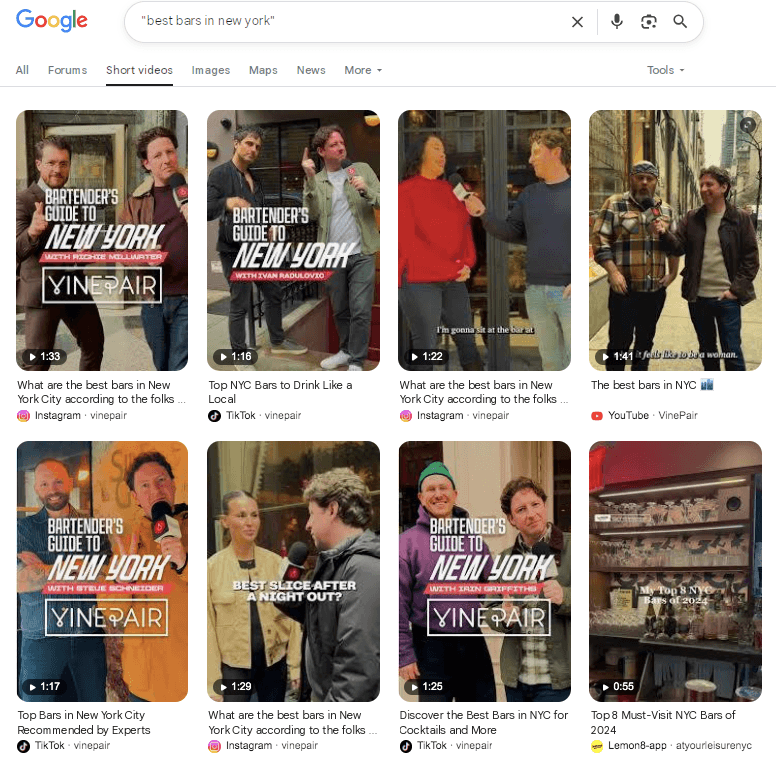
Source: Google
However, most people will have a particular social platform that they prefer to use for particular types of social search. They may use a forum site like Reddit when looking for conversation and advice about a brand or topic, or head to TikTok or Instagram when looking for more visual ideas and quick insights.
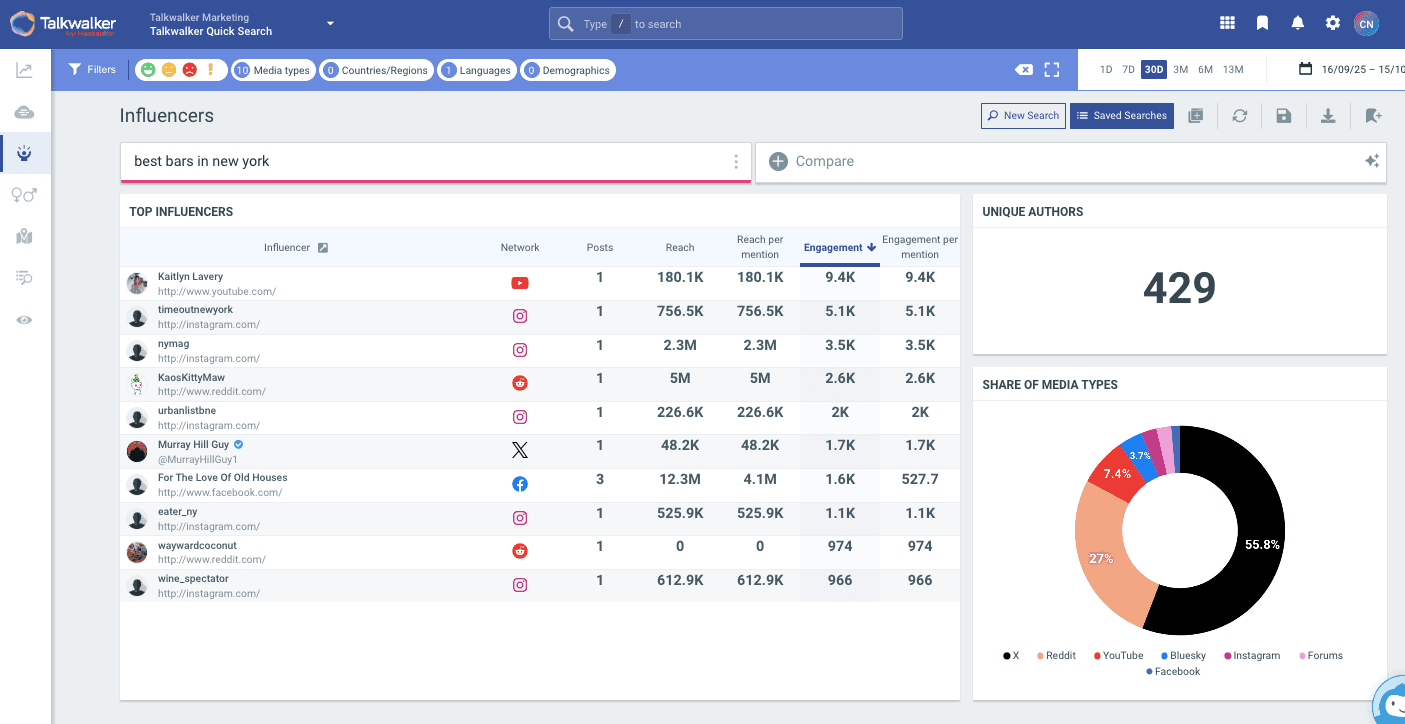
On the brand side, there is still no one social search engine, but there are definitely tools (like Talkwalker) that search across social platforms to show you what’s being said about a specific topic, including your brand. You can get big data, like how many social conversations about your brand are out there, where they’re happening, and what the sentiment is within them. You can also get specific social media content results, like a list of the most engaging content or social posters with the greatest reach.
What sets social media search apart from traditional search?
Community-driven trust
One huge difference of social media search versus traditional search is that it’s more inclusive. Not everyone has a website for traditional search engines to crawl. But just about everyone has at least one social media account.
That means the pool of content resources that social search draws from is completely different from that of a traditional search engine. Traditional search engines tend to provide results from brands, organizations, publications, and other entities that have an official website. Of course, this has recently been changing as traditional search results have started to include more results from Reddit, Quora, and social platforms (as well as AI summaries), but traditional search ranking factors are still very much in play.
Social media search, though, can deliver results from anyone, with no gatekeepers.
On the one hand, this is great. Rather than seeing just what a company has to say about their products, you can get real insights from people who actually use the products, in real time. You can connect with members of an existing online community and get their advice and recommendations.
It’s great for brands, too, as long as they’re doing a good job. Recommendations within social communities are a valuable form of social proof. The trust within those communities gives your brand far more credibility than you could create with your own traditional SEO content.
Of course, there is also a downside. There are fewer checks on misinformation in social search, making it critical for brands to keep an eye on what other people are saying about them on social platforms while also striving to appear in social search results themselves. (More on both of these topics later in this post!)
Algorithmic discovery
Social media algorithms often know us better than we know ourselves. That means social searches are personalized to a far greater degree than search results in a traditional search engine.
Search terms are still critical to the discovery process, but the results are based on all the signals you’ve sent to the social platform about what interests you and what does not. Social search is more likely to understand the intent behind your search without much additional information. Content from creators you know and trust will come out on top. Content that’s engaging others like you will also top the results.
In fact, sometimes social media algorithms know us so well that social search doesn’t really start as a traditional search at all. Instead, information comes into your feed before you even think to search for it. This can actually be the trigger of a search for more information. The keyword-based search still happens, but it's not necessarily the first step in the process.
Shifting trends
Trends evolve fast on social media, and so does the language that goes with them. Hashtags and themes on social platforms may have a whole culture behind them that would be tricky to find in real time using traditional search engines.
At the same time, the vast number of social interactions with a theme or topic every day help train social platforms about what’s popular or trending far before traditional search engines catch on.
Visual-first results
Traditional search engines are built to deliver text-based resources in response to keyword searches.
That can mean a lot of skimming and scanning to try to find the information you’re looking for.
On visual-first social platforms, searches lead to visual-first results. Images and short videos can be easier (and more entertaining) to process, making them the preferred way to gather information for many people who have grown up immersed in these platforms.
Social search results are inherently snackable, but just like with any tasty snack, it’s hard to stop at one. So social search might start off with the idea of looking for quick results, but its highly compelling and personalized nature means it’s easy for a simple search to turn into a very deep dive.
4 advanced social media search tactics marketers need to know
For marketers, mastering social search is about much more than uncovering the latest trends (although that’s important too). Using advanced search tactics helps you assess your own brand visibility in social search results, track your competitors, and identify the influential voices in your niche that can help get your brand seen.
1. Learn native social tools
Each social platform’s search works a little differently, but they all have built-in tools to help narrow your search and find what you’re looking for.
Hashtags are the most common tools for social search and apply across most platforms. Any trend will have an associated hashtag. They’re usually pretty intuitive. If you’re not sure which hashtags will deliver the most relevant content, try starting with a keyword search to surface results, then checking which hashtags are most commonly used. You can also start to type a hashtag in the search bar on most platforms and see a list of autocomplete suggestions.
Advanced queries are also important, but they vary a little across different platforms – except for Boolean operators, but we get into those in the next section of this post. For now, let’s look at a few of the most common advanced query options for each platform:
X (Twitter) operators
from:account – sent from the named account
list:list-name – sent from a social media profile included on the named list
to:account – a reply to the named account
filter:media – Tweets containing an image or video
filter:links – Tweets containing links
:) and :( – sentiment filters for a positive or negative attitude
There are actually quite a few more operators you can use to refine your X search and get the precise results you’re looking for. Get more details in our post about X Advanced Search.
Tiktok search refinements
Start to type a search phrase in the TikTok search bar, and the platform will automatically suggest additional terms to add to your search string to create a more focused search. You can also use the refinements tabs at the top of the search screen to narrow your results to:
Users
Videos
Sounds
Live
Shop
Learn more in our post on how to use TikTok search.
Reddit flair
Reddit post flair is a system of tags unique to each subreddit that helps categorize posts and comments and makes things easier to find. Some subreddits require each post to have a flair, but not all do.
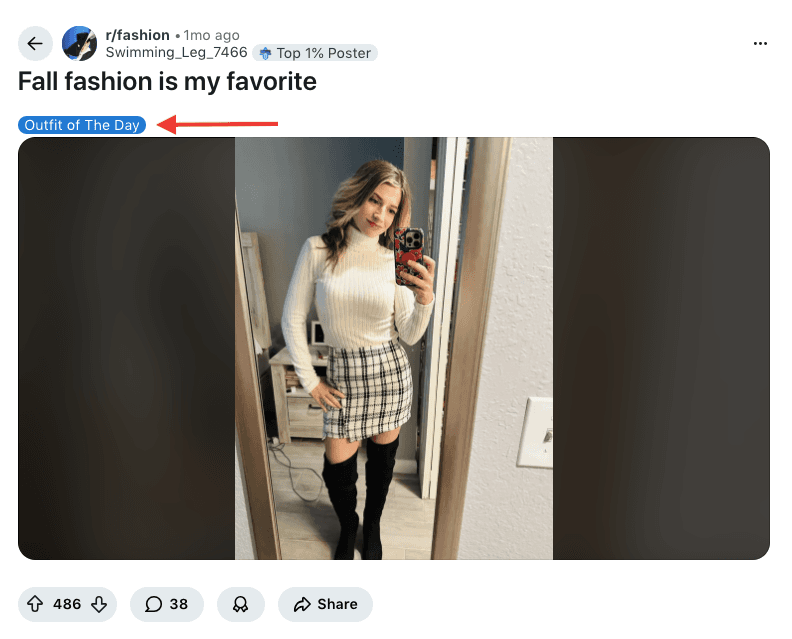
You can click on the flair to find all posts with that flair.
Reddit user flair is similar, but it applies to the user instead of the post. User flair is also unique to each subreddit, so one user could have many different user flairs, but only one will show up in each subreddit.
2. Use smart Boolean searches
Boolean searches work across almost all search engines, including traditional search engines like Google and most social search bars. Boolean operators allow you to get very specific with your search.
The most basic Boolean operator is quotation marks, which narrow your search results to an exact phrase. Without quotation marks, the search provides results that include any combination of the words in your search string.
We’ve got a whole blog post on how to use Boolean operators, but here’s a quick cheat sheet of some of the most important ones:
AND: Narrow your results by specifying multiple terms to include in your search
OR: Expand your search by including possible alternatives
NOT: Narrow your search by excluding certain keywords
3. Search cross-platform for a panoramic view
As we mentioned above, there’s not technically a single social media search engine to provide useful content results for consumers. However, for marketers, Talkwalker is an effective cross-platform social media search tool.
Searching across platforms is important because trends, and even popular opinion, can vary from one platform to another. You can’t assume that your online brand reputation is safe because people love you on the platforms where your brand is most active.
Talkwalker has a couple of free tools to help here.
Talkwalker Free Social Search
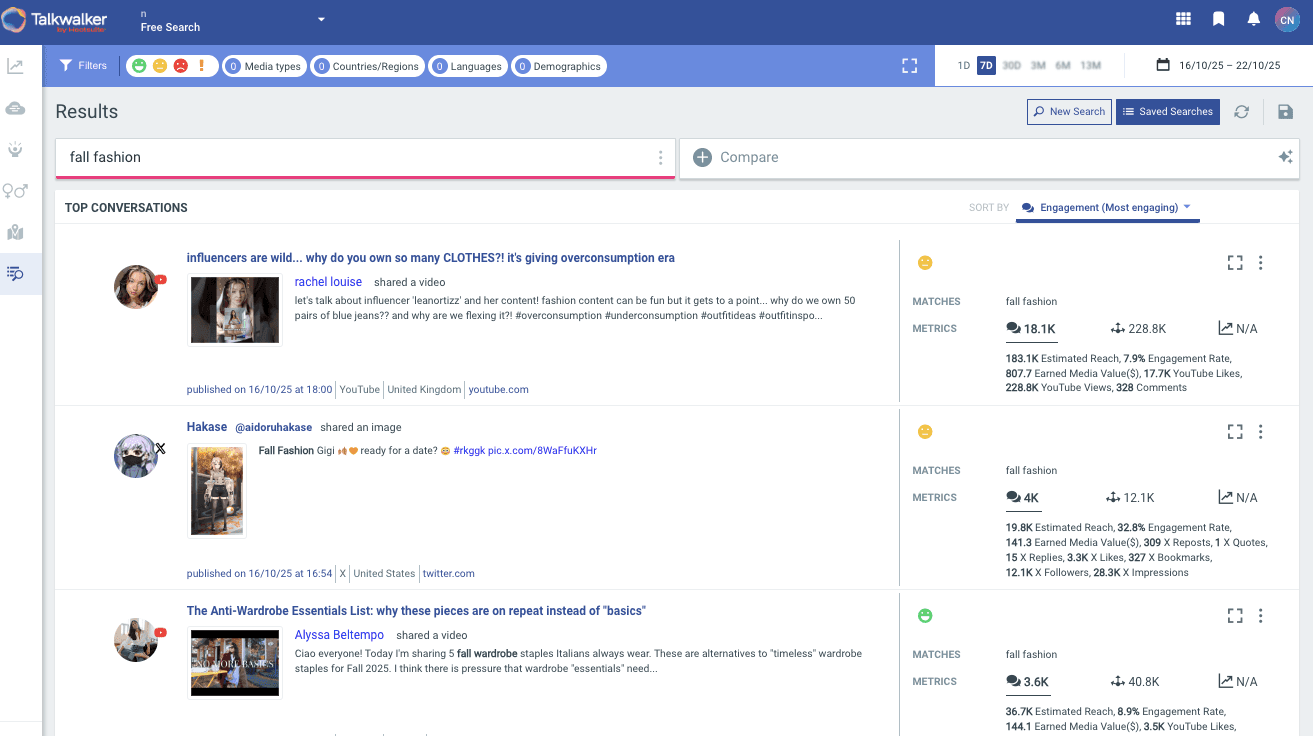
Get real-time search results for social content in 186 languages across all social meda platforms. You can create your own custom search or use the AI query builder to create a search string for you.
You can see key metrics for your search, like results, sentiment, and engagement level, top themes, and even the demographics of people posting about your topic.
At the post level, you can find a list of the top influencers and even the specific posts getting the most engagement
Talkwalker Alerts
This free tool is like an alternative to Google Alerts, with the power to monitor X (Twitter) and discussion forums as well as web results.
You can choose to get alerts in real time, or digest alerts on a set schedule.
4. Scan for visual mentions
As we already said, one of the main benefits of social search is visual-first results. That means that brands need to scan visual mentions in order to have the full picture of their social search visibility.
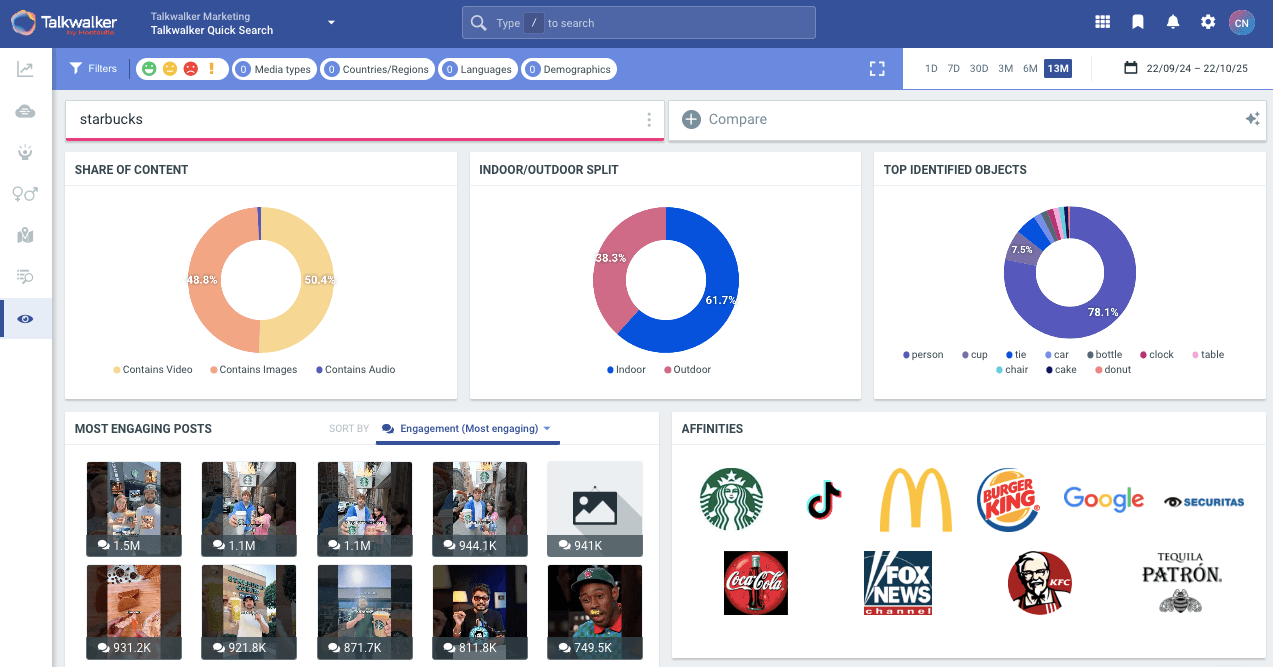
The full version of Talkwalker includes image recognition, visual insights, reverse image search, and video analysis to make sure your social search results include all mentions of your brand. You can also see your share of content (for images, videos, and audio), and understand what the top identified objects are that appear in content about your brand.
Optimizing your brand strategy for social search visibility
Uncover real audience language
To find what people are really saying about your brand, or about a specific topic or trend, you need to search like they speak.
Start by exploring trending topics, keywords, and hashtags in your industry using a tool like Talkwalker’s Free Search tool or Quick Search. You’ll start to uncover the actual words and phrases your audience is using in real time. You can then add these to your search query using Boolean operators. Don’t forget to include common misspellings.
Identify and act on emerging trends
Use a tool like Talkwalker to identify emerging trends and topics in real time, including the most important creators and hashtags in the space. Audience Insights tools in Talkwalker help you understand how different audience segments are engaging with a trend, so you can make sure you focus your efforts on your specific target market.
You can then use these insights to create relevant content right at the start of a trend’s bell curve, so you benefit most from social search when the trend is at its peak.
Map search intent to content types
The way people phrase their social search query tells you a lot about what they’re actually looking for, so you can create the right content to show up in the results on the right platform.
For example, “how to” suggests that people are looking for tutorials, whereas “ideas” suggests they are more broadly looking for inspiration. Think about the different intent behind these two searches:
How to wallpaper a small room
Small room wallpaper ideas
Here are some ideas to get you started
Intent | Sample search terms | Best content formats | Best platforms |
Information/education | How to, What is, Why does, Ways to, Explained | Tutorials, explainer videos, guides, infographics | TikTok, YouTube, Pinterest |
Inspiration | Ideas, Inspiration, Aesthetic, Inspo | Moodboards, Reels | Instagram, TikTok, Pinterest |
Recommendations | Best, Top, Recommended, Vs, Must-have | Demo videos, reviews, Q&As | Reddit, TikTok, YouTube |
Advice | Worth it, Tips for, Review, Scam, Opinion | Polls, Questions, Stitches | Reddit, X, TikTok |
Safeguard your brand reputation
Social search is a prime way for people to learn more about brands. They often start their search with queries like “brand + review” or “brand + scam.”
Social listening with a tool like Talkwalker allows you to catch changes in social sentiment early, so you can manage crises and make it right with any social users who are calling you out for valid concerns. You can also publish content addressing concerns before they escalate.
Win at social search with social listening
You’ve seen that social search is a powerful discovery engine for both consumers and brands. But visibility without insight is guesswork.
Social listening ensures that you understand the intent behind social search so you can show up in the right places with the right content, and streamline monitoring risks to your reputation.
Here’s how Talkwalker allows brands to increase visibility by showing up in the right social contexts while protecting your reputation through real-time monitoring, sentiment analysis, and proactive risk management.
1. Set up comprehensive social search monitoring
Set up search queries using Boolean search operators to track relevant keywords, hashtags, and brand/product names, including common misspellings.
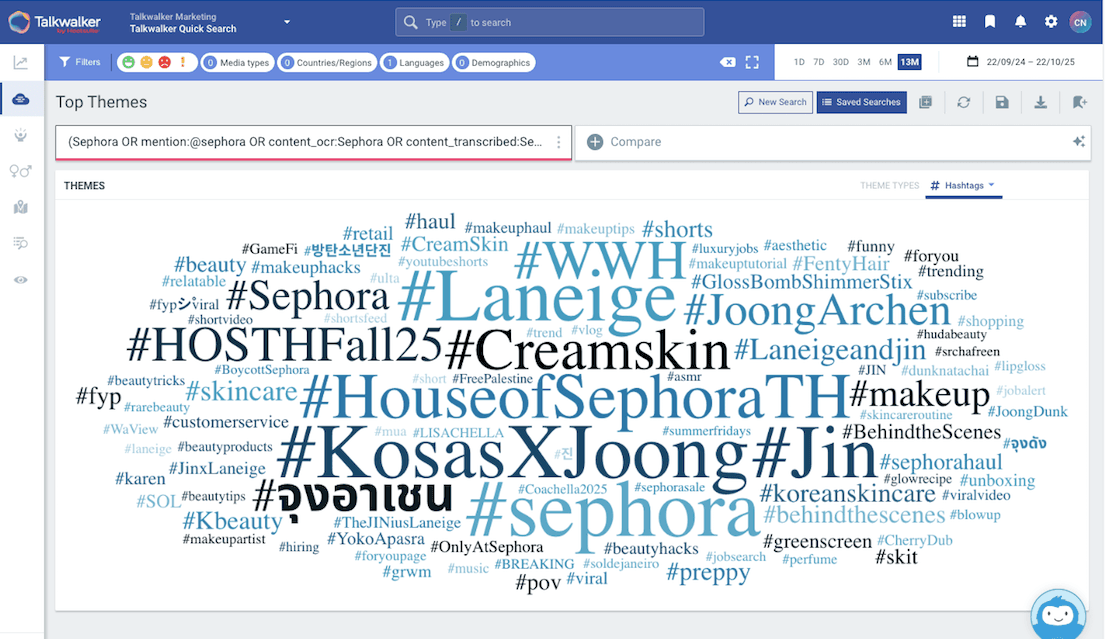
Then track which influencers are talking about your brand, who is engaging with your content and other social content that mentions your brand. Analyze social sentiment to understand whether the overall results for your brand in social search are trending positive or negative. You can also see how visible you are compared to your competitors by looking at social share of voice.
2. Monitor your reputation
Set up real-time alerts for negative spikes in sentiments or a sudden increase in social mentions.
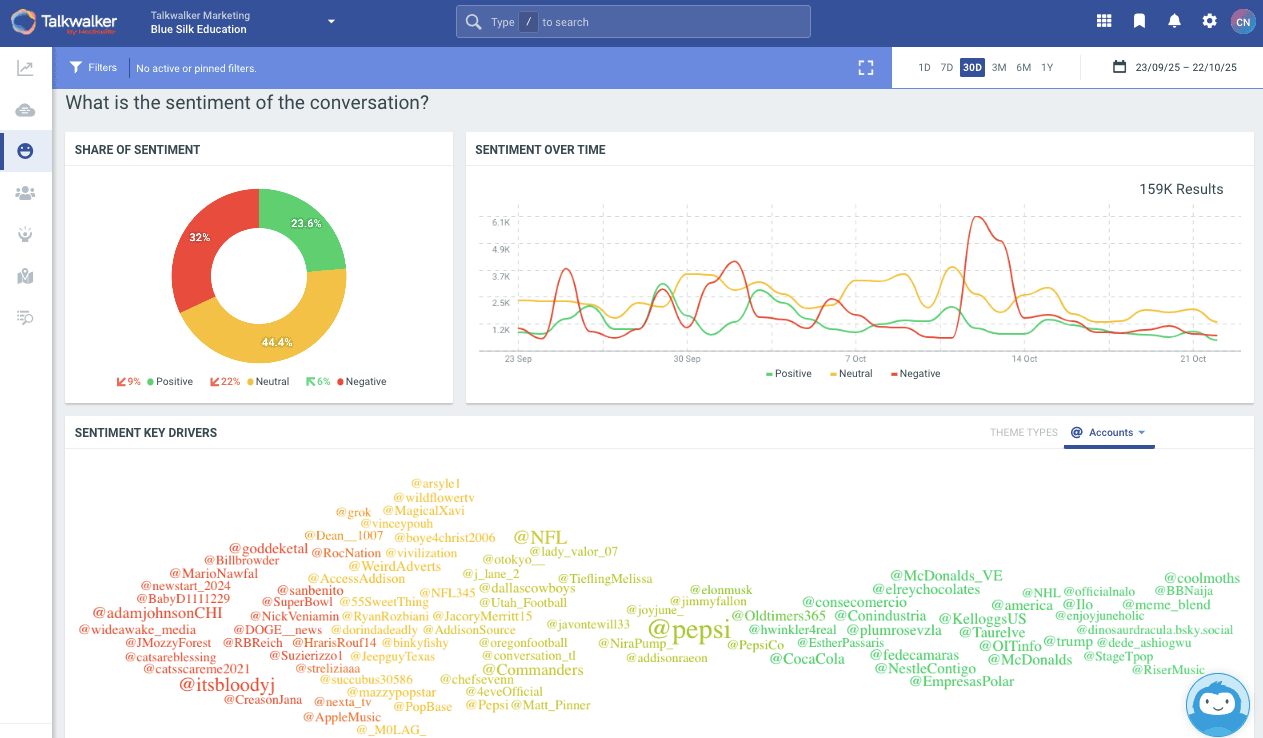
Use Talkwalker’s AI-powered sentiment analysis to detect shifts in perception. Your social search monitoring will also help you identify emerging issues and competitor activity so you can respond with appropriate content that ranks for the right social search terms. You can see what (and who) is driving the social sentiment, so you can address the root causes.
3. Create a unified strategy that balances visibility and reputation
Talkwalker’s analytics dashboards have widgets to help you measure the impact of your campaigns and messaging in real time, so you can understand how they impact your share of voice for the most relevant social searches.
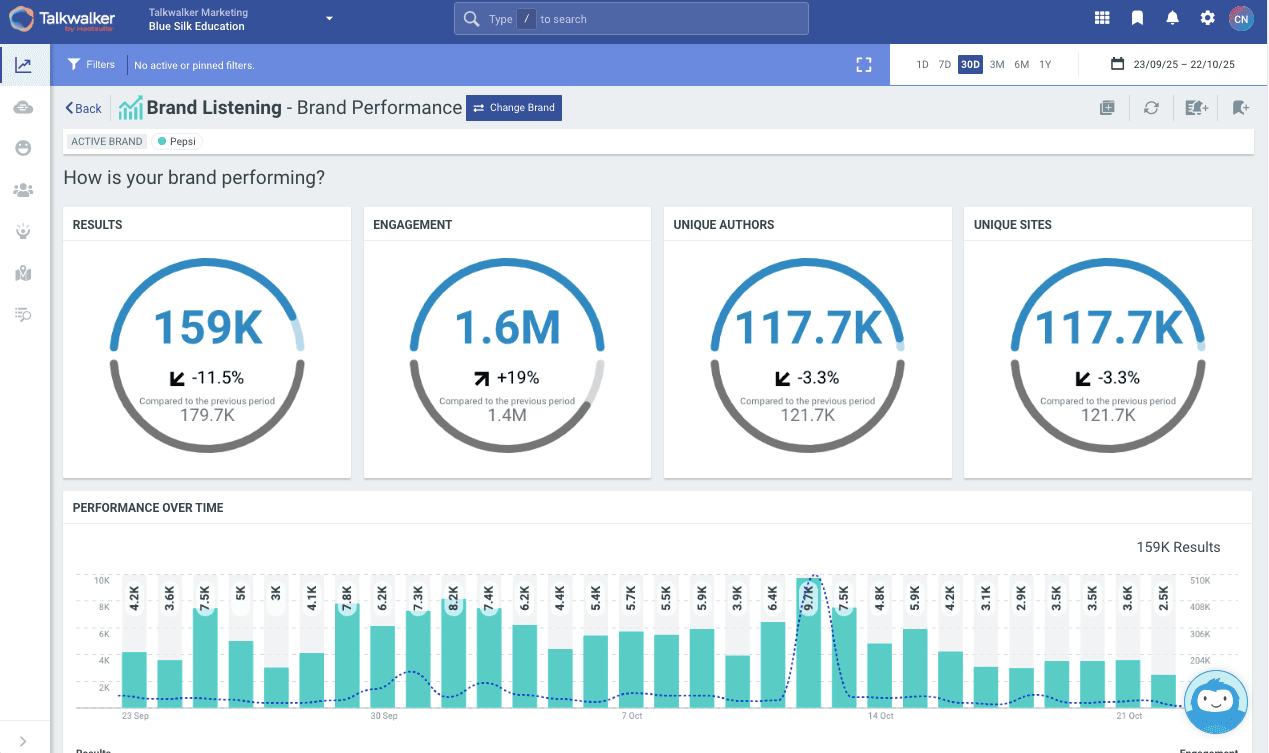
You can also set up custom dashboards to track visibility metrics like share of voice and top themes alongside risk indicators like negative sentiment. Being able to visualize both together helps you balance proactive brand building through social search with brand protection.
Ready to turn social media search into a real advantage? Book a Talkwalker demo to see how our cross-platform social listening, visual insights, and real-time alerts help you boost visibility, spot trends early, and protect your brand reputation.