Social listening: A 2025 guide for marketing, PR, and insights
Unlock the power of social listening to boost your marketing strategy with actionable insights, trend spotting, and improved brand reputation management.
November 14, 2024
Social listening is market research supercharged. Rather than asking a small group for feedback, you can tap into billions of conversations happening on social platforms every day. You can understand how people really feel about your brand, your products, your industry, and your competition.
You can use social listening data to guide your social media strategy, inform your content creation plans, spark new product ideas, and help you avoid PR crises. It has the potential to impact any customer-facing aspect of your business.
In this guide, we'll cover everything you need to know about social media listening—from strategy setup to real-world case studies.
What is social listening?
Social listening means monitoring social media for mentions of your brand, your competitors, your product, and any other themes relevant to your business. Then, you analyze the data for actionable insights.
Some of the main goals of social listening are to:
transform scattered social media conversations into strategic insights,
jump on relevant social media trends,
deliver a better experience for your customers,
grow your brand while protecting your reputation.
What are social listening tools?
Social listening is virtually impossible without specialized software. Dedicated social listening tools like Talkwalker gather quality data from a wide range of sources. You never have to search each platform manually. The tools compile the data into useful charts, graphs, and other analytics tools that help surface actionable insights.
Some factors to consider when choosing a social listening tool are:
Platform coverage across social networks, forums, and platforms like Reddit and Quora. Broad coverage ensures you don’t miss relevant conversations.
Visual listening capabilities to catch references to your brand in photos and videos.
Enhanced search settings using Boolean operators and custom filters. Or, even better, an AI search tool that creates detailed queries for you.
Real-time monitoring and notification/alert capabilities.
Advanced analytics for sentiment analysis and brand monitoring.
Report customization and benchmarking features.
What's the difference between social listening and social media monitoring?
These terms are often used interchangeably. However, they serve different purposes in your social media marketing strategy.
Social media monitoring is mainly about compiling data. It’s gathering information about what’s already happened vs. looking forward to determine future actions.
Social listening digs deeper. It involves analyzing social mentions and conversations to gain actionable insights. It's proactive and strategic, helping you understand the 'why' behind customer behavior and industry trends.
What is the primary focus of social listening?
Social listening works to help you understand deep patterns and trends in how people perceive you. Not just what they say directly about you (or to you).
This offers powerful insights for different teams. The primary focus for all teams is using social data to understand what people are saying online. Then, you analyze that data to guide your strategy.
The specific benefits of social listening can look a little different in each department.
Social listening for social media marketing
The overall focus for social marketers is to gain a deeper understanding of your customers and your place in the industry. You can then create more effective marketing campaigns. Here’s what that could look like in practice:
Identify new trends and content themes so you can get on board early.
Benchmark your marketing efforts against your competitors to look for ways to improve your content strategy.
Understand your share of voice and identify ways to get a bigger piece of the pie.
Build closer, more authentic relationships with your audience.
Identify important influencers in your industry.
Prove the impact of your work in terms of ROI and brand health.
Social listening for PR and communications
For PR and communications, the main focus of social listening is to monitor sentiment, brand awareness, and brand reputation.
Knowing how people feel about your band allows you to develop an effective communications strategy. You can boost positive perceptions of your brand while addressing concerns and misinformation.
Social media listening also helps you with crisis management. You will identify potentially serious issues before they escalate into social media crises.
Social listening for insights and business strategy
The main focus for insights and business strategy is to gain a rich, accurate data set. This serves as the foundation for strategic decision-making across the organization.
It can reveal:
Your audience’s key pain points
Industry problems your audience cares about most
Gaps between customer needs and current solutions
Emerging trends and customer behavior shifts
How your results compare to your competitors (for benchmarking)
Social listening for customer service
By monitoring customer sentiment and conversation patterns, you can spot and address customer concerns almost instantly.
It’s really the only way to get customer feedback in real time across multiple social media channels.
It can help you to:
Respond in real time to individual customer questions, concerns, compliments, and complaints.
Identify and escalate emerging issues to develop a coordinated response plan.
Identify recurring concerns that could impact product development, pricing, or tech support.
Overall, the goal is to improve the customer experience. You can do that by providing faster, more consistent customer support and developing stronger relationships with your customers.
How to get started with social listening
There are a lot of details in social media listening, and it may feel a little overwhelming. We’ll walk you through the practical details of setting up a social listening workflow in the next section.
But first, let’s take a high-level look at how to get started. You can essentially think about social listening as a four-step process:
Determine your goals. These will determine which data you want to track, which metrics you want to focus on, and what your benchmarks are
Set up your queries. These are the search strings your social listening tool uses to find your data.
Analyze your findings. Look at what the data is telling you.
Apply your insights. Circle back to your goals and determine how you will translate your social listening insights into strategic action.
How to put social listening into practice: From queries to insights
Once you’ve determined the goal of your social listening plan, it’s time to set up your social listening tool. Here’s how to gather, analyze, and report on your social listening data in Talkwalker.
1. Build your queries
Queries are the search strings that you use to retrieve social listening data. You should track relevant keywords, hashtags, and trending topics based on your social listening goals. For example, you could track:
Brand names
Product names
CEO and spokesperson names
Competitor names
Industry terms
Campaign hashtags
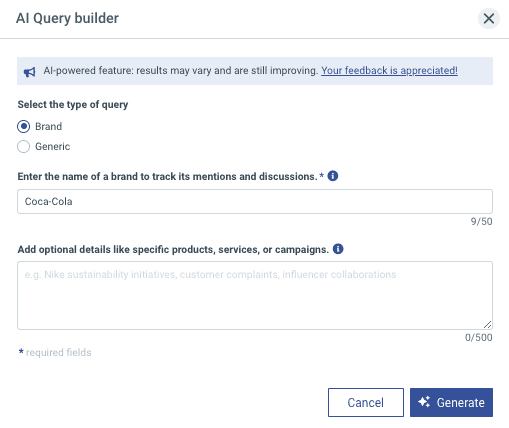
To narrow your results, you’ll use Boolean operators. You can build your query manually. Or you can use the AI Query builder in Talkwalker to build a precise query automatically.
__CONTENTFUL_MEDIA_1__
You can then narrow your results further to make them even more relevant by filtering by language, location, media type, and source.
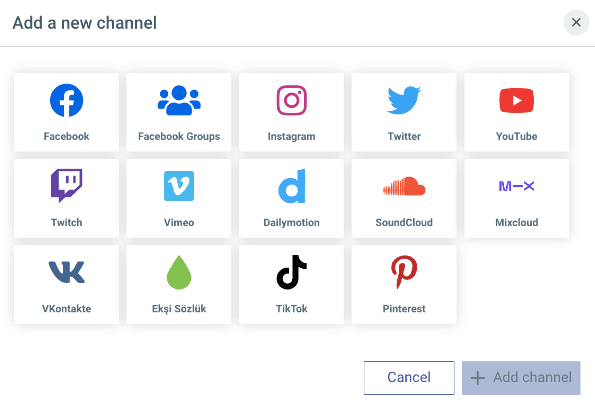
2. Choose your channels
Again starting with your goal as your guiding principle, choose the channels you want to monitor. Social media marketers will likely want to focus on social media platforms. PR and communications teams might preference news sites. Customer service might want to
Real social listening examples
1. Tracking an online trend: The Labubu craze

Mentions of Labubu from Aug 21, 2023 to Aug 21, 2025; 10% sample; Talkwalker Social Listening; Source
By now, you have almost certainly heard about Labubus. These cutely weird monster toys have been in production since 2019, but odds are you first heard about them in spring or summer 2025. That’s when online conversations about the brand spiked from hundreds of mentions per week to hundreds of thousands.
Talkwalker’s analysis of the trend shows it follows the usual pattern:
A small but dedicated fanbase forms early.
An online event acts as a catalyst to drive the trend from obscurity to the mainstream.
The trend grows organically through memes, media coverage, influencer posts, and online buzz until the online presence is saturated.
The trend reaches so far beyond the fan base that public opinion sees a downturn.
The trend starts to fade, with mentions settling into a more consistent level that’s significantly lower than the spike.
Social listening helps brands identify a trend like this so they can get on board early and ride the buzz before it disappears.
Check out our full analysis of the social data surrounding the Labubu trend for more details and insights.
2. Measuring sentiment alongside mentions: "Spitgate" at the NFL Kickoff game
An uptick in social media posts about your brand is great, right? Well, not always. While increased mentions of your brand could indicate the beginning of a trend or a positive catalyst event, it could also indicate that something has gone sideways.
For example, let’s look at the online conversation about four NFL players over the kickoff week starting September 4.
For context, a quick recap. Two of these players were involved in an incident dubbed “spitgate.” The Philadelphia Eagles defensive star Jalen Carter was caught spitting at the Dallas Cowboys quarterback Dak Prescott during an argument. Carter was ejected from the game for unsportsmanlike conduct. Replays later suggested Prescott may have spat at Carter first.
(Did you ever think you would read so much about spit in a post about social listening? Let’s get back to the analysis.)
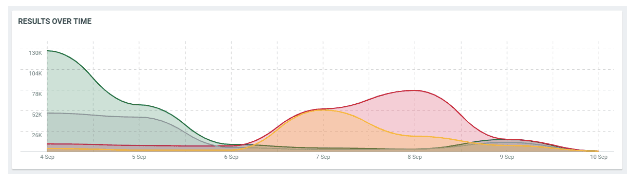
Mentions of key NFL players over 7 days: Jalen Carter (green), Dak Prescott (silver), Aaron Rodgers (gold) and Josh Allen (red); Talkwalker Social Listening; Source
Looking at mentions alone, Carter had the greatest volume of the week – 218.8k mentions. Prescott was in second place for mentions at the start of the week.
But remember, these mentions were driven by a gross, penalty-inducing incident. In contrast, the other two players in this analysis saw increased mentions based on their accomplishments. Josh Allen set the record for most rushing touchdowns in Buffalo Bills history, and Rodgers led his team to a close victory over a team that fired him last year.
So, it’s important to look at sentiment to see the full story.
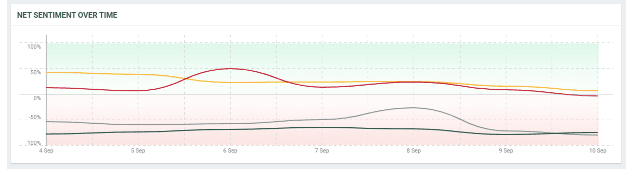
Net sentiment: Jalen Carter (green), Dak Prescott (silver), Aaron Rodgers (gold) and Josh Allen (red); Talkwalker Social Listening; Source
Here, it’s clear that the players involved in spitgate had consistently low sentiment. Meanwhile, the players who drew attention for their play were well into positive sentiment territory.
This is important context for any brand looking to partner with a third party, like an influencer or celebrity. And the same concept applies when tracking mentions of your own brand. Don’t assume a spike in mentions is a good thing until you check the associated sentiment!
Find more in-depth analysis of social listening data related to the opening week of the NFL in our full case study.
Actionable tips for social listening success
1. Create a response plan based on sentiment store
Have a template in place for your social team to respond to mentions, with different guidance on positive, neutral, or negative mentions. This can improve response time and consistency.
Also, put an escalation plan in place with guidance for dealing with net sentiment scores outside your acceptable range. This can help you address potential crises while they are still in the early stages, or take advantage of a surge of positive chatter about your brand.
2. Keep a consistent eye on the competition
Social listening offers a wealth of data about your own brand. But it is also an incredible source of competitive analysis. Talkwalker’s Competitive Intelligence IQ App tracks your performance against your top competitors, so you can always keep an eye on share of voice.
On a more granular level, you can see how people perceive your brand compared to your competitors, and whether that’s changing. This gives you the opportunity to get ahead of any big moves that could impact your brand.
3. Create an effective system of alerts
With a social listening tool like Talkwalker, you can check in on your real-time reports any time you need data. But you can also set up alerts so that in more urgent situations, the data comes to you.
For example, you can set up alerts to let you know if the volume or sentiment of the conversation about your brand spikes or dips.
You can also set alerts to let you know when influential accounts (over your chosen follower count) mention your brand. These mentions create the opportunity for engagement with a new audience by joining the conversation as it unfolds.
What does the future hold for social listening?
Hootsuite’s 2025 Social Media Trends Report found that social listening improved ROI confidence for marketers across all social platforms.
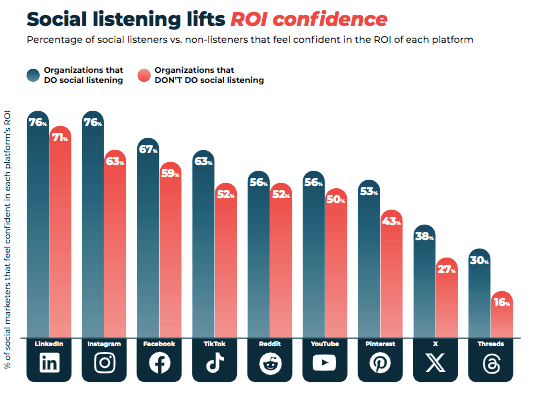
The same report found that marketers in just about every industry – including heavily regulated industries – are embracing AI for everything from idea generation to content creation.
As these two trends converge in the coming years, social listening tools will offer marketers ever more nuanced audience insights. For example, the best social listening tools (like Talkwalker) are already going beyond simple sentiment categories of positive/negative/neutral to identify the specific emotions connected to a conversation. This will help marketers understand the data more accurately. After all, a sad conversation requires a very different response from an angry one.
As social platforms become increasingly focused on visuals rather than text, image and video brand recognition will become more important. So will the ability to access social data from forums like Discord and Reddit. AI will also get better at recognizing itself, so your data focuses on conversations from real people.
All of this will allow marketers to better understand their customers. Brands with a solid social listening strategy in place will be able to personalize content for very specific market segments based on highly detailed aspects of their demographics, behaviors, and expressed preferences.
One thing that will not change is social listening’s impact on ROI, and ROI confidence. That symbiotic relationship is here to stay.
Stay ahead of trends, safeguard your brand health, and uncover what your audience really cares about. Talkwalker tracks billions of conversations and turns them into your competitive edge. See it in action.
{{cta('261047136466','justifycenter')}}