
How to conduct a brand health check
A brand health check is an analysis of how your brand is performing compared to your goals, and competitors.
January 24, 2024

Performing a brand health check will show you how successful your brand is in your market. It’ll provide insights into aspects that need improving. Here’s why an audit is crucial for business success, and the 8 steps to conduct your brand check.
What’s a brand health check?
Simply put, it’s about how your brand is performing. Both within your market and compared to your competitors?
A brand health check, or brand audit, is a deep dive into your business’ current position in the marketplace. It can
Identify differences in your brand identity or tone of voice.
Uncover gaps in your marketing strategy, such as new countries you should be targeting
Finds the social channels your audience is using, where you don’t have a presence.
Uncovers your strengths and weaknesses.
A brand health check is an analytical study of the numerous aspects that make up your brand. It includes -
Internal branding
External branding
Customer experience
Brand values, mission, USP
Brand logo
Sales process
Product and/or service
Corporate identity
Customer support
Brand positioning
Visual assets
HR policies
Marketing strategy and goals
Events
User experience
Company culture
Website and blog
Ideal consumers
Print and paid advertising
Brand attributes and voice
Sponsorships
Competitor analysis
Marketing material
PR
Social media
Content marketing
Email marketing
Brand messaging and tone of voice
SEO - search engine optimization
A brand health audit will be different depending on your company, industry, and aims. At minimum, it should…
Show how successful/unsuccessful your brand is
Identify strengths and weaknesses
Ensure your business strategy targets customer needs
Identify your brand’s market presence compared to your competitors
Why is a brand health check important?
If it isn’t broken, don’t fix it.
You need a brand check process if you want to change any aspect of your business. From redesigning your email template to changing your logo.
Whether it’s a tweak or a complete overhaul, you must understand what’s working and what isn’t. Why it’s working or not. Otherwise, you could cause more harm than good.
When to do a brand health check
Reasons to consider conducting a brand audit include…
You’re changing your business focus
Branding is not consistent across your company
Your marketing campaigns aren’t bringing results
Traffic to your website is low
Sales are dropping
Brand awareness has reduced
The email open rate has dropped
Customer loyalty is weak
But, the audit process is not just for when things look bad. There are positive reasons to perform a brand audit...
You’re launching a new range of products
Your startup has outgrown your brand strategy
Your business has outgrown your website
You’re looking to open global offices
With success, comes competitor analysis
Key benefits of a brand health check
Doing a brand audit will show you how your company is performing. It’s too easy to sit back, assuming that everything is working well. When in reality, things are starting to go wrong.
Highlight inconsistencies in your marketing strategy. Pain points that could damage your sales, website traffic, conversion rate, email open rate, and more.
Is your branding out of date? Launched eight years ago, your startup identity was spot on. Today it looks tired, targeting is off, and it's limiting your growth.
Your brand isn’t perfect. Fix it.
If your brand is riding on a wave of success, don’t relax.
It’s the best time to do brand health tracking. Identify what’s working, and understand why.
Take a look at what your competitors are doing. Are they launching new products? Targeting new countries?
Analyze and stay ahead.
How to measure brand health
For brand health measurement, you should focus on the metrics that capture different aspects of your brand's performance.
These key brand health metrics include:
Net Promoter Score (NPS) to measure customer loyalty
Purchase Intent to gauge potential sales
Share of Voice helps assess your brand's visibility compared to competitors
Sentiment Analysis offers insights into public perception
Monitoring Time on Site and Social Media Engagement provides data on brand interaction online.
Each of these metrics offers valuable insights and combined gives a well-rounded picture of your brand's overall health. We’ll dive into some of these metrics below.
8 steps to perform your brand health check
1 - What’s the goal of your brand audit?
Remember the potential reasons for doing a brand audit?
You’re changing your business focus
Branding is inconsistent
Failing marketing campaigns
Website site traffic has dropped
You’re not getting sales
Losing social media engagement
Emails aren’t converting
Etc.
What’s not working? The answer to that question will be the focus of your brand health research. And yes, it could be everything.
2 - Where does your brand currently stand?
This is where you evaluate the status of your brand as it stands today. How much you analyze, will depend on the scope of your brand audit. It’s data that’s readily available to you. Initially look at…
Mission statement and values
Marketing strategy
Unique selling points - USPs
Strengths and weaknesses
Market positioning in your industry
Company branding
Target market and competitive edge
Website purpose and usage
Competitors
Drilling down - again, it depends on the scope of your audit - questions to ask include...
Website
Is it easy to navigate?
Are there loading issues?
Is it mobile-responsive?
Does it convert?
Does it rank highly in search engines?
Is branding and tone of voice consistent
Branding
Does our logo represent our company?
Is our language/branding consistent across all teams?
Content
What’s the open or click rate of our emails?
Are we placing paid ads on the best channels?
Is our messaging resonating with consumers?
Are we using the right tone of voice/language?
Do we have a presence on the right social media channels?
Does our visual branding represent our messaging?
Customers/competitors/team
What do consumers think of our brand?
What do consumers think of our competitors?
What do employees think of our brand?
Are consumers/influencers recommending our products?
Are employees happy to recommend our products?
Conduct a SWOT analysis for your brand. It’s a method that’ll help you find the strengths, weaknesses, opportunities, and threats surrounding your brand.
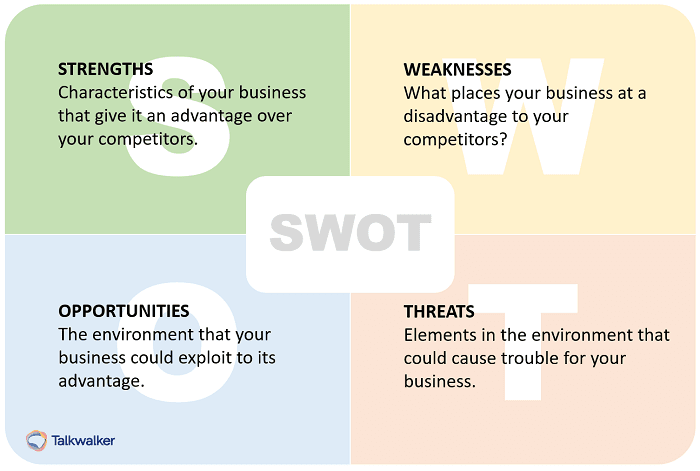
SWOT analysis as part of your brand audit.
SWOT examples
Strengths - quality of your marketing material, competitive pricing, level of customer support
Weaknesses - shipping costs, new product design flaw
Threats - strong brand competition, government policies and regulations
Opportunities - market expansion, new stakeholders
3 - Talk to your customers
Surveys, polls, feedback forms, review sites, Net Promoter Score - NPS, are great ways to understand your consumers. Find out what they think about your
product quality
pricing
delivery process
website
social media channels
customer support
etc.
Customers can make or break your brand. If they’re happy, you’ve got the best brand advocates. Unhappy, and you’ve got a big problem to solve.
You need to find out what they think about your brand. What they’re saying about your brand. What influences their buying decisions.
This process can take time. It depends on how much data you’re collecting, and response time. Don’t start making changes until you’ve gone through all the data.
Surveys
Online surveys are a great way to collect customer feedback. Ask open questions, not questions with yes/no answers, for more detailed responses.
What do they think of your brand? Why did they buy your product, rather than competitors? Do they find your website easy to navigate?
Polls
Limited compared to surveys, polls are quick to create and respond to. You’ll get good feedback, but because the number of questions is limited, you’ll need several polls.
You can create polls on social media, or embed them on your website and in blog posts.
Pay close attention to the language and words used by customers in your surveys and polls. If these are the words they’re using, you should be including them in your marketing content.
Listen to people. Talk their language.
Net Promoter Score - NPS
A tenfold increase in NPS can lead to a 3.2% increase in upsell revenue.”
Net Promoter Score measures customers’ satisfaction with a brand. It’s a loyalty metric. To determine an NPS score, you ask a single question…
“How likely is it that you would recommend our company/product/service to a friend or colleague?”
The NPS opinion scoring system is on a scale of 0-10. 0 means very unlikely and 10 means extremely likely. Customers are categorized based on their scores.
--- No. of promoters - No. of detractors ÷ respondents x 100 = NPS ---
Detractors score 0-6
Passives score 7-8
Promoters 9-10
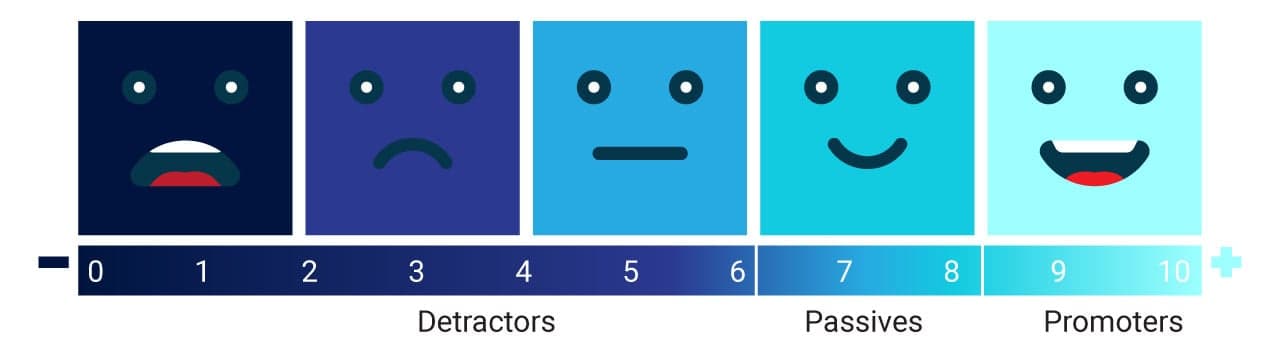
You can find out more about NPS in our Net Promoter Score Guide
4 - Audit your website
You probably run a website analysis regularly. It’s the most efficient way to see
How your content is performing
How your audience is reacting to your website
The countries interacting with your content
Whether your website is working
If your website is pretty, but if it’s not converting, it’s failing. Google Analytics is a free tool that provides historical and real-time data. It’s a must for your brand audit.
Traffic analysis
Are you getting visitor traffic to your website? How much? Where’s it coming from?
A spike in traffic to your website from a country you’re not targeting is good and bad. Great, it’s highlighting a new market. Bad, because… why aren’t you targeting it?
If traffic is low, you have to understand why. Are there navigational issues? Slow loading?
Review your marketing content. Is it too hard-sell? Too technical for consumers to understand? Or, just plain boring?
You can also use Google Analytics to see where your traffic is coming from. Social media, direct via a search engine, paid campaign, email. This will help you understand the content that’s working. You can then tweak and improve, delete, or replicate.
Bounce rate
Your bounce rate is the percentage of visitors that land on your website, and then bounce away. If it’s too high, you have a problem. It means your content isn’t working, it’s unclear or the message doesn’t match the H1 title. Or there are technical issues like broken links, slow loading, etc.
Conversion rate - CVR
How many times was the form on your landing page completed? How many downloads of your latest customer case study?
Conversion rate is a metric that shows if you’re reaching your goals. A low conversion rate indicates that you need to make changes.
Pageviews
By knowing which pages are viewed, and which are ignored, you can identify the best campaigns and content. This website analytics metric will help you when it comes to updating your marketing strategy.
5 - Social media listening data review
There are valuable insights on consumers on social media. Your social media audit will identify your likes, shares, retweets, pins, referrals, and more. You’ll also learn about your audience - age, gender, interests, and sentiment.
How’s your social media marketing performing?
Are your paid social ads bringing results?
What types of consumers are engaging with your brand?
Are they part of your target audience?
What comments are they posting about your brand and products?
While social media channels have inbuilt analytics tools, dedicated social listening tools will provide more data.
Your social media channels are full of brand conversations. Not all are good. But, all are valuable.
The Talkwalker platform enables you to perform a comprehensive analysis of the data surrounding your brand. Features include predictive alerts, AI-powered insights, and image & video analytics.
Monitor all your brand mentions
Track brand-specific or targeted keywords
Benchmark against competitors, industry standards, and sentiment
Optimize and refine ads and content to improve brand health
6 - Review sales results
Again, this should be something that your business is doing already. Include these in your brand audit to reveal customer buying behavior, industry trends, etc.
Have your sales dropped? Identify why.
Is it down to your competitors launching new products? Are you pricing too high? Did you fail to deliver on your brand promise? Did a PR crisis cause lasting damage?
7 - Conduct competitor analysis
Competitive analysis is an in-depth study of your industry and its members’ strengths and weaknesses.
This process will identify improvement opportunities within your marketing campaigns including targeting, SEO, content, leads, conversions, revenue, etc.
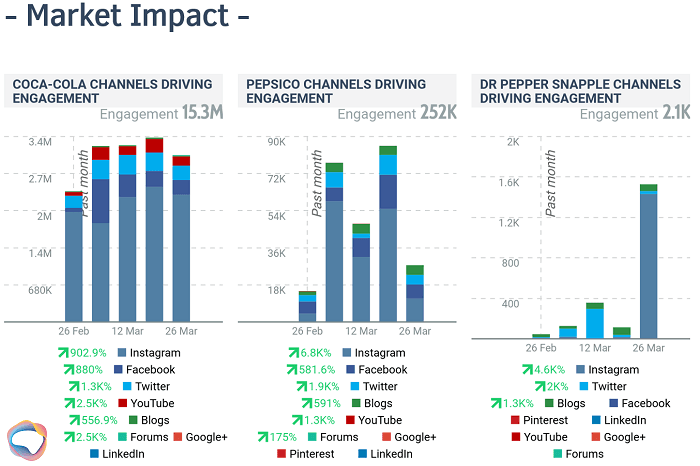
Brand audit showing the market impact demonstrating strategy across networks - simulated report from Talkwalker Social Benchmarking
You can read more in our Competitor Analysis Guide but in summary, it will
Help improve your marketing strategies
Identify opportunities in your market that you’re missing
Enable you to take advantage of your competitors' weaknesses to increase market share
Help you make data-driven decisions and increase your competitive advantage
First up…
Identify how your competitors talk to consumers. Messaging, tone of voice, and the language they use. Analyze their websites, and see what they offer. Look at their marketing material, paid ads, and social media channels.
If you find things that you’re not doing so well, or not doing at all, replicate it where possible.
Monitor your competitors’ SEO strategies. The keywords they’re targeting and ranking for. You’ll need a tool for this, like Ahrefs.
8 - Action plan and monitoring
Now, you should have a list of action points or ideas on how to improve your branding. Whether it’s branding, marketing strategy, email campaigns, social media strategy, etc.
Start by separating into quick wins and long-term wins. For instance, consumers could be avoiding your forms as you’re asking for too much information. Quick win? Shorten them.
Long-term wins will take time and maybe multiple teams. Schedule these for later implementation. Such as your brand audit results suggest that your website content is confusing and putting potential customers off. This is a bigger project.
Monitor your changes
Begin monitoring, as soon as you start putting your changes in place. Depending on the changes, monitor:
Brand awareness
Customer feedback
Social media engagement
Conversion rate
Email open rate and click-through
Sales
Changes in ROI
Review results to see if the improvements are working.
Ask consumers - It makes sense to go back to the source. If they raised issues with certain aspects of your brand, ask if you’ve met their requirements.
A/B test - it’s crucial to A/B test all your changes, so you can monitor the impact. But also, so you can revert if the results are bad.
Takeaway
To monitor your brand health and improve your brand’s reputation, social benchmarking is key. Click below to learn how Talkwalker Social Benchmarking helps you keep an eye on your campaigns, competitors, and more.
{{cta('92303005422','justifycenter')}}