
Trend insights
Swift-Kelce wedding: Audience insights based on 5.6M online conversations
Taylor Swift and Travis Kelce's long-awaited wedding generated massive online buzz. See what social listening data reveals for fans and marketers.
July 6, 2026

- Methodology
- Coverage at un unprecedented scale
- Who owned the conversation
- FOMO-induced negative sentiment
- Where the love lived, and where the friction did
- Celebrated abroad, interrogated at home
- Brand share of voice
- The guest list was the content
- Who was actually talking
- What the conversation clusters reveal
- The $26 million counter-narrative
- Six lessons marketers can take from the most-watched wedding of the year
- The bottom line
Screens around Madison Square Garden lit up on the evening of July 3, 2026 with two words: “JUST&T MARRIED.” Taylor Swift and Travis Kelce were married, and almost no one outside the building had seen it happen. No livestream, no leaked footage, no official photos for hours.
The secrecy held. The silence did not.
Between June 30 and July 6, Lumen by Talkwalker tracked 5.6 million posts about the wedding and everything orbiting it, with 628.3 billion in potential reach on the Taylor Swift topic alone. The most private celebrity wedding in recent memory became one of the most public online events of the year.
The data holds a few surprises. The loudest single thread was the $26 million the couple gave to charity, louder than the dress, the venue, or the vows. The criticism concentrated in the United States while the rest of the world mostly celebrated. And two luxury houses owned the fashion conversation without buying an ad. Here is what the numbers reveal, for Swifties and marketers alike.
Methodology
This analysis is based on data from Lumen by Talkwalker, our AI-powered social listening platform. We tracked public online conversation about the wedding of Taylor Swift and Travis Kelce from June 30 to July 6, 2026, a 7-day window covering the build-up, the wedding day, and the immediate aftermath. Across that period, the topic captured 5.6 million results across social networks, news sites, blogs, and forums.
A few definitions for the metrics used throughout:
Results are individual public posts or mentions that match a query.
Engagement counts the reactions, comments, shares, and similar interactions those posts received.
Net sentiment is the share of positive minus negative mentions, with sentiment classified by Lumen's AI.
Potential reach estimates the size of the audience that could have seen the conversation, based on author followings and site traffic.
Share of voice compares how often a brand or person is mentioned. We report two counts: an overall count across the full dataset, and an in-conversation count limited to mentions inside the focused wedding discussion.
Coverage at un unprecedented scale
Start with the raw size. Mentions of Taylor Swift alone generated 2.4 million results, up 406% compared to the prior week, with 74.3 million engagements and a potential reach of 628.3 billion.
Mentions of the wedding ceremony and Travis Kelce each passed a billion in the reach column too. These are numbers usually reserved for a global sporting final, generated here by one couple saying “I do.”
Topic | Results | Engagement | Net sentiment | Potential reach |
Taylor Swift | 2.4M | 74.3M | 6.79% | 628.3B |
Wedding | 1.2M | 42M | -11.53% | 432.7B |
Travis Kelce | 1.1M | 44.4M | 31.32% | 439.8B |
Madison Square Garden | 600.2K | 26.6M | -6.07% | 303.9B |
Wedding guests | 110.8K | 6.3M | 9.16% | 236.5B |
Officiant | 95.2K | 4.4M | 5.22% | 81.5B |
Just&t married | 46.7K | 3.4M | 39.78% | 44.7B |
Rehearsal dinner | 39.5K | 2.5M | 39.92% | 95.3B |
Wedding fashion | 32.7K | 2.1M | 54.42% | 70.4B |
Wedding performances | 23.6K | 731.4K | 73.01% | 52.4B |
NDAs | 7.6K | 325.8K | -9.53% | 15.9B |
Source: Lumen by Talkwalker, June 30 – July 6, 2026. Net sentiment is the balance of positive minus negative mentions; potential reach estimates the audience exposed to the conversation.
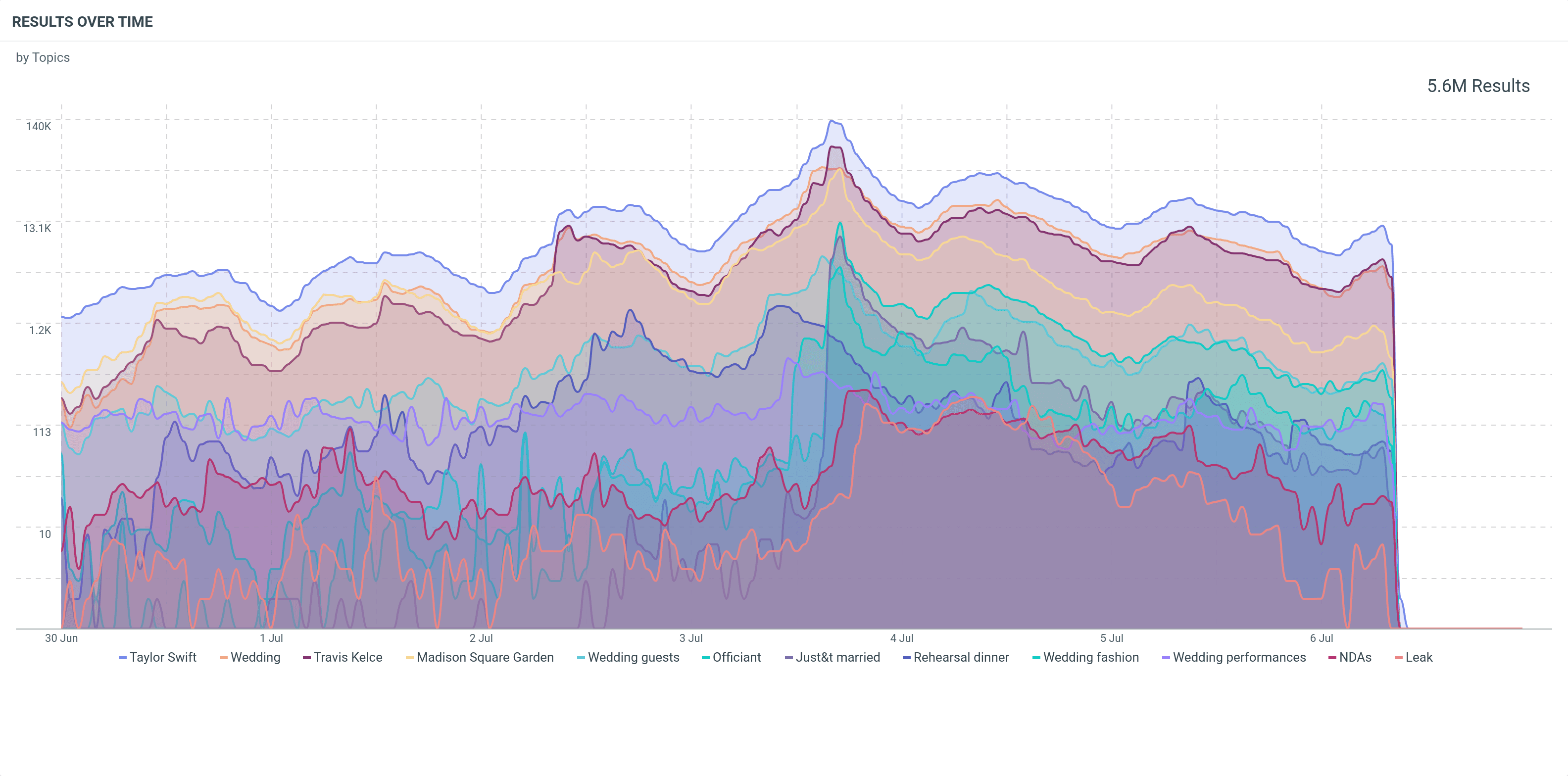
Timing tells the second half of the story. Volume built steadily through the week, then spiked hard on July 3, the wedding day, reaching a daily peak of roughly 140,000 posts as the “JUST&T MARRIED” confirmation hit. A second wave followed on July 4 as guests left the venue and the first images surfaced. The conversation did not need the ceremony to be visible to explode. It only needed confirmation that it had happened.
Source: Lumen by Talkwalker
Who owned the conversation
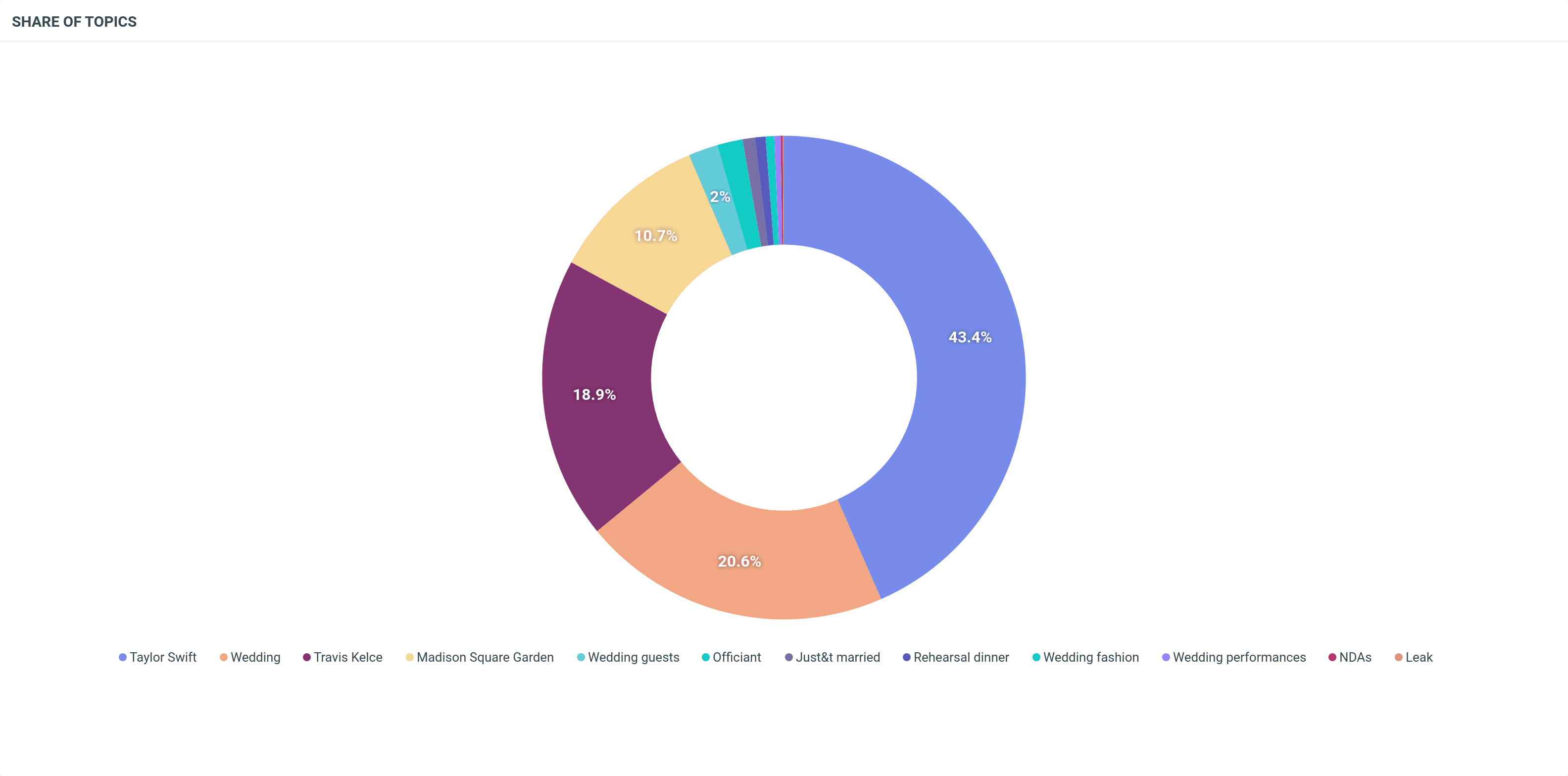
Four topics did most of the heavy lifting. Mentions of Taylor Swift took 43.4% of the tracked conversation, followed by the wedding ceremony at 20.6%, Travis Kelce at 18.9%, and Madison Square Garden at 10.7%. Everything else, from the officiant to the fashion to the NDAs, split the remaining sliver.
Source: Lumen by Talkwalker
One contrast is worth pausing on. Swift drove far more volume, but Kelce drove warmer sentiment. His topic carried a net sentiment of 31.32%, against Swift's 6.79%. The groom was along for a friendlier ride, while the bride absorbed the full weight of scrutiny that comes with being the most-discussed woman on the internet.
FOMO-induced negative sentiment
The couple's control tactics became their own conversation. Two small but revealing topics tracked the information the public was denied: NDAs and leaks.
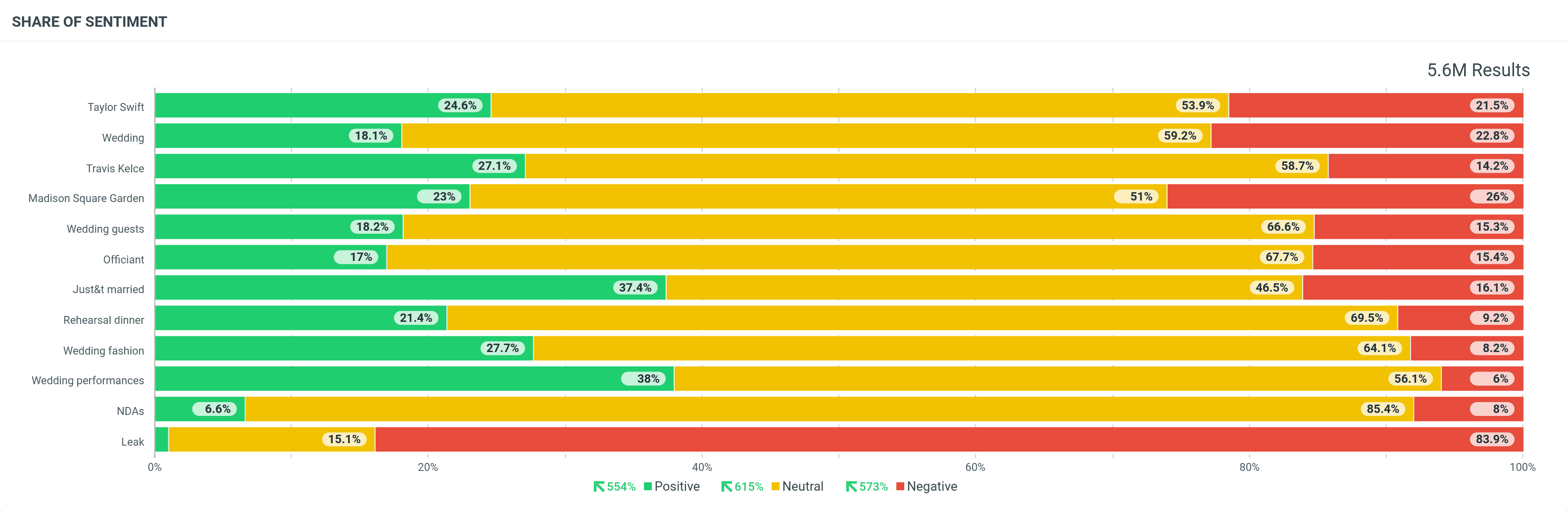
The topic of media leaks was the most negative in the entire dataset, with net sentiment of -97.62% and 83.9% of mentions negative. This is the sound of an audience frustrated by a blackout, hunting for scraps of footage and turning on anyone accused of breaking the seal. The NDAs topic, by contrast, sat almost entirely neutral at 85.4%, read more as a fascinating logistical fact than a grievance.
The strategy mostly worked. By locking down phones, guests, and footage, the couple forced the public to talk about the wedding on the couple's own timeline, releasing confirmation and imagery when they chose. The cost was a pocket of intense negativity from an audience that felt shut out. That tension, control versus access, is the single most transferable lesson in this dataset for any brand planning a high-secrecy launch.
Where the love lived, and where the friction did
Sentiment was not evenly spread. The topics closest to the celebration itself were overwhelmingly warm, while the topics closest to the real world were where the friction showed up.
The warmest corners
Wedding performances led on positivity, with net sentiment of 73.01% and only 6% negative mentions.
Wedding fashion followed at 54.42% net sentiment, the standout for brands (more on that below).
Rehearsal dinner and the Just&t married moment both landed near 40% net sentiment, driven by genuine delight at the announcement.
The friction points
The Wedding topic itself was net negative at -11.53%, a reminder that the umbrella conversation carried the criticism the celebratory sub-topics did not.
Madison Square Garden ran 26% negative, the highest negative share among the major topics, tied to street closures and the disruption of a holiday weekend in Manhattan.
Source: Lumen by Talkwalker
The takeaway is not that the wedding was unpopular. It is that audiences separate the spectacle from its consequences. People loved the dress and the first dance. They were sharper about closed streets, a guest list that drew moral objections, and the optics of an eight-figure celebration during a cost-of-living squeeze.
Celebrated abroad, interrogated at home
Negative coverage and commentary were not evenly distributed around the world.
The United States drove the conversation by a wide margin, with 1.4 million results and 610.1 billion in potential reach, far ahead of any other market. It was also net negative, at -10.72%. The same held across the other big English-speaking markets: the United Kingdom at -18.22% and Canada at -10.27%.
Outside the Anglophone world, the story flipped. The largest international conversations came from Latin America, and they were overwhelmingly warm: Brazil (400.9 thousand results, +33.18% net sentiment), Colombia (183.1 thousand, +28.19%), Mexico (108.1 thousand, +31.02%), Spain (104.8 thousand, +22.99%), and Argentina (69.5 thousand, +33.81%). India, too, leaned positive at +23.46%.
Market | Results | Net sentiment | Potential reach |
United States | 1.4M | -10.72% | 610.1B |
India | 47K | 23.46% | 27.7B |
United Kingdom | 52.8K | -18.22% | 21.5B |
Brazil | 400.9K | 33.18% | 8.5B |
Spain | 104.8K | 22.99% | 4.6B |
Argentina | 69.5K | 33.81% | 4.5B |
Mexico | 108.1K | 31.02% | 2.7B |
Canada | 56.5K | -10.27% | 2.2B |
Colombia | 183.1K | 28.19% | 712M |
Source: Lumen by Talkwalker, June 30 – July 6, 2026. Markets shown are a selection ranked by potential reach. Green denotes positive net sentiment, red negative.
This is the geographic signature of the criticism running through the US conversation: closed streets in Manhattan, a guest list that drew moral objections, and the optics of a lavish celebration during a cost-of-living squeeze. Those concerns were local. Everywhere else, the wedding was mostly just a joyful global event.
For a brand, that gap is an opportunity. The celebratory international audience, especially across Latin America, engaged at scale with almost none of the friction that shaped the US conversation. A moment that looks contentious at home can be pure upside a border away.
Brand share of voice
The fashion story looked, at first, like a footnote.
The wedding fashion topic was small by volume at 32.7 thousand results, a rounding error next to the 2.4 million on Swift herself. But it carried the second-highest net sentiment of any topic at 54.42%, and the brand data shows why it mattered far more than its size suggests.
Lumen tracks brand mentions two ways: an overall count across the full dataset, and an in-conversation count that captures mentions inside the focused wedding discussion. Comparing the two separates the brands people were talking about from the brands that were merely cited as sources.
Brand | Overall mentions | In-conversation mentions |
TMZ | 30,815 | 292 |
New York City Police Department | 10,773 | 171 |
Kansas City Chiefs | 6,854 | 648 |
National Football League | 6,279 | 716 |
2,784 | 481 | |
Christian Dior | 2,015 | 2,013 |
Cartier | 1,297 | 1,295 |
Source: Lumen by Talkwalker brand detection, June 30 – July 6, 2026. Overall = mentions across the full dataset; in-conversation = mentions within the focused wedding discussion.
The gap is the insight. TMZ came in with the largest overall count at 30,815 mentions, but only 292 of those sat inside the actual conversation. The New York City Police Department (10,773 overall, 171 in-conversation) and the sports entities followed the same pattern. These names show up because they appear in news copy and bylines, not because people were discussing them.
The luxury brands behaved in the opposite way. Christian Dior recorded 2,015 overall mentions and 2,013 in-conversation, a near-perfect 1:1 ratio, and Cartier did the same with 1,297 and 1,295. Almost every mention of these brands was a real, on-topic mention. People were not citing Dior; they were talking about it.
The guest list was the content
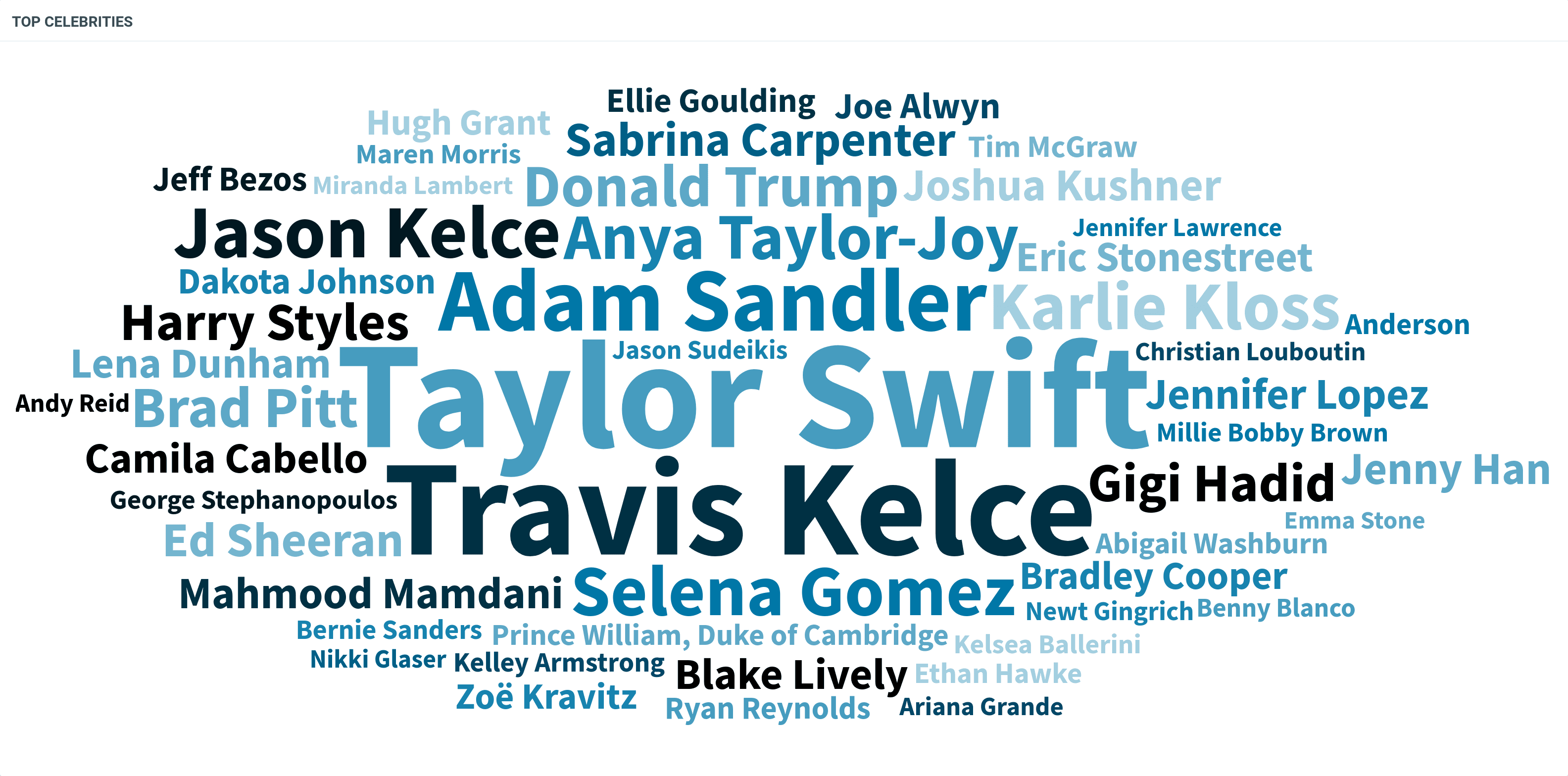
A 1,000-person guest list is a content engine, and the entity data shows it. After the couple themselves, the most-mentioned names reveal how many separate stories the wedding spun off.
Source: Lumen by Talkwalker
Adam Sandler, the officiant, drew roughly 92,000 mentions. An unexpected, warm detail became one of the day's most shareable facts.
Selena Gomez anchored the friendship-and-fashion storyline and earned her own conversation cluster around her wedding-day looks.
Blake Lively carried the drama subplot: a rumored friendship fallout, with Ryan Reynolds and ex-partner Joe Alwyn pulled in for the inevitable callbacks.
Musicians including Sabrina Carpenter, Ed Sheeran, Ariana Grande, and Harry Styles fueled non-stop performance speculation.
The most telling names are the ones with no wedding invitation. Donald Trump was among the most-mentioned figures of all, joined by political names like Bernie Sanders and Newt Gingrich. Swift's every move is read through a political lens, and the wedding was no exception. That is both the reach and the risk of her cultural gravity: the conversation will not stay in the lane you built for it.
The pattern for brands and media planners: a major cultural event is rarely one story. It is a dozen, each with its own audience. The couple supplied the headline; the guests, and the people who were not even there, supplied the long tail.
Who was actually talking
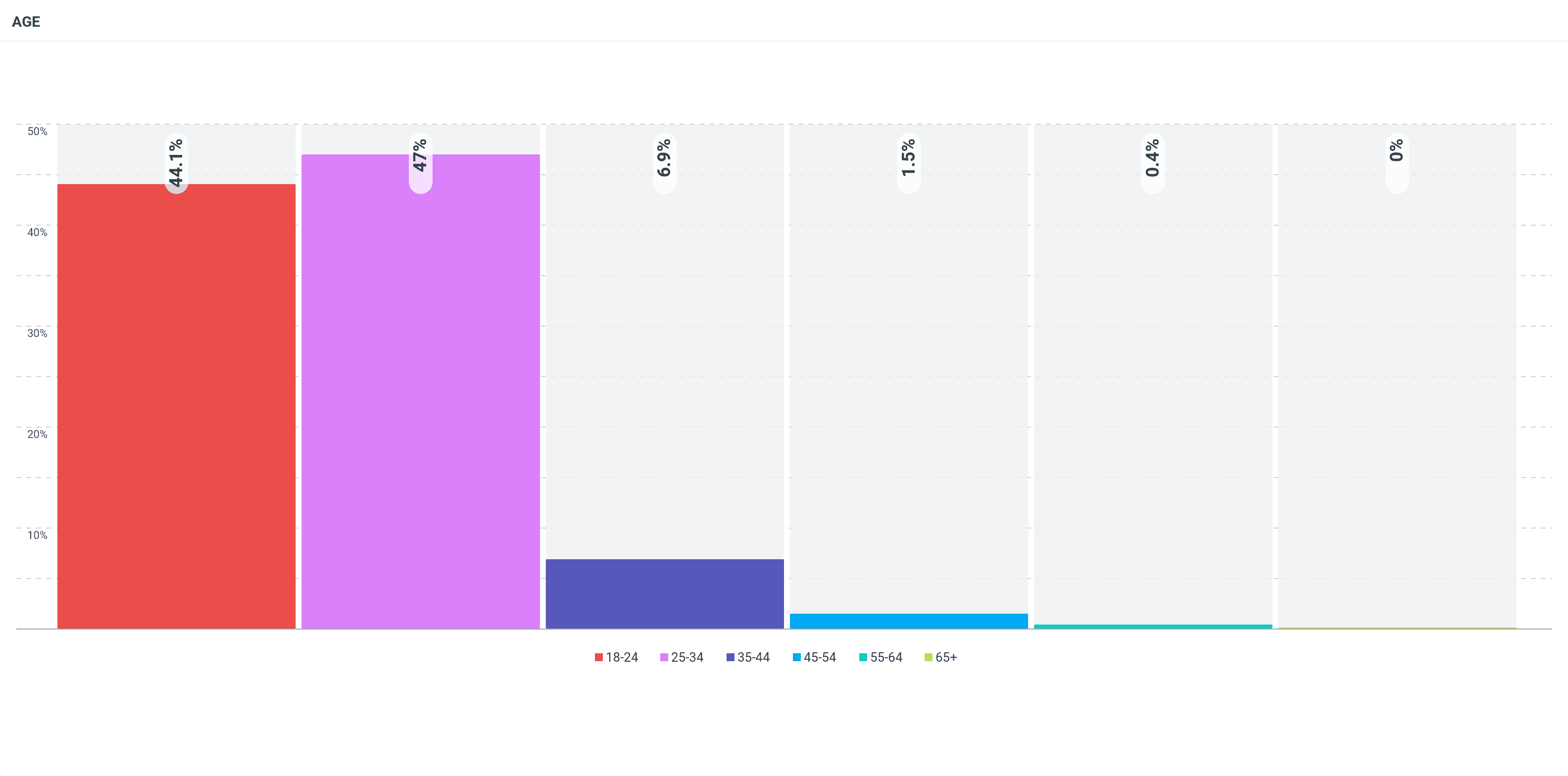
The audience skewed young and female. 91% of the conversation came from people under 35 (44.1% aged 18–24 and 47% aged 25–34), with the 35–44 band a distant third at 6.9% and everyone over 45 barely registering.
Source: Lumen by Talkwalker
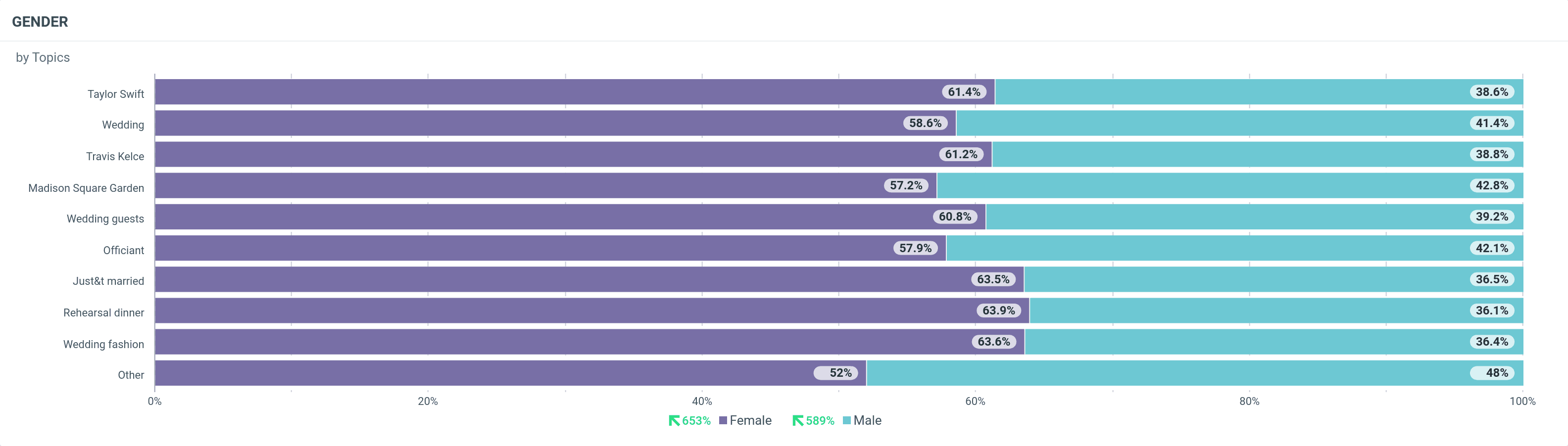
Across the core topics, women drove 57% to 64% of the conversation, peaking on the rehearsal dinner, the fashion, and the “Just&t married” moment.
Source: Lumen by Talkwalker
That profile matters. This was not a broad, all-ages news event like an election or a championship. It was a concentrated Gen Z and younger-millennial conversation, largely led by women, playing out on the platforms that demographic lives on. Any brand hoping to ride the moment needed to already be fluent there.
What the conversation clusters reveal
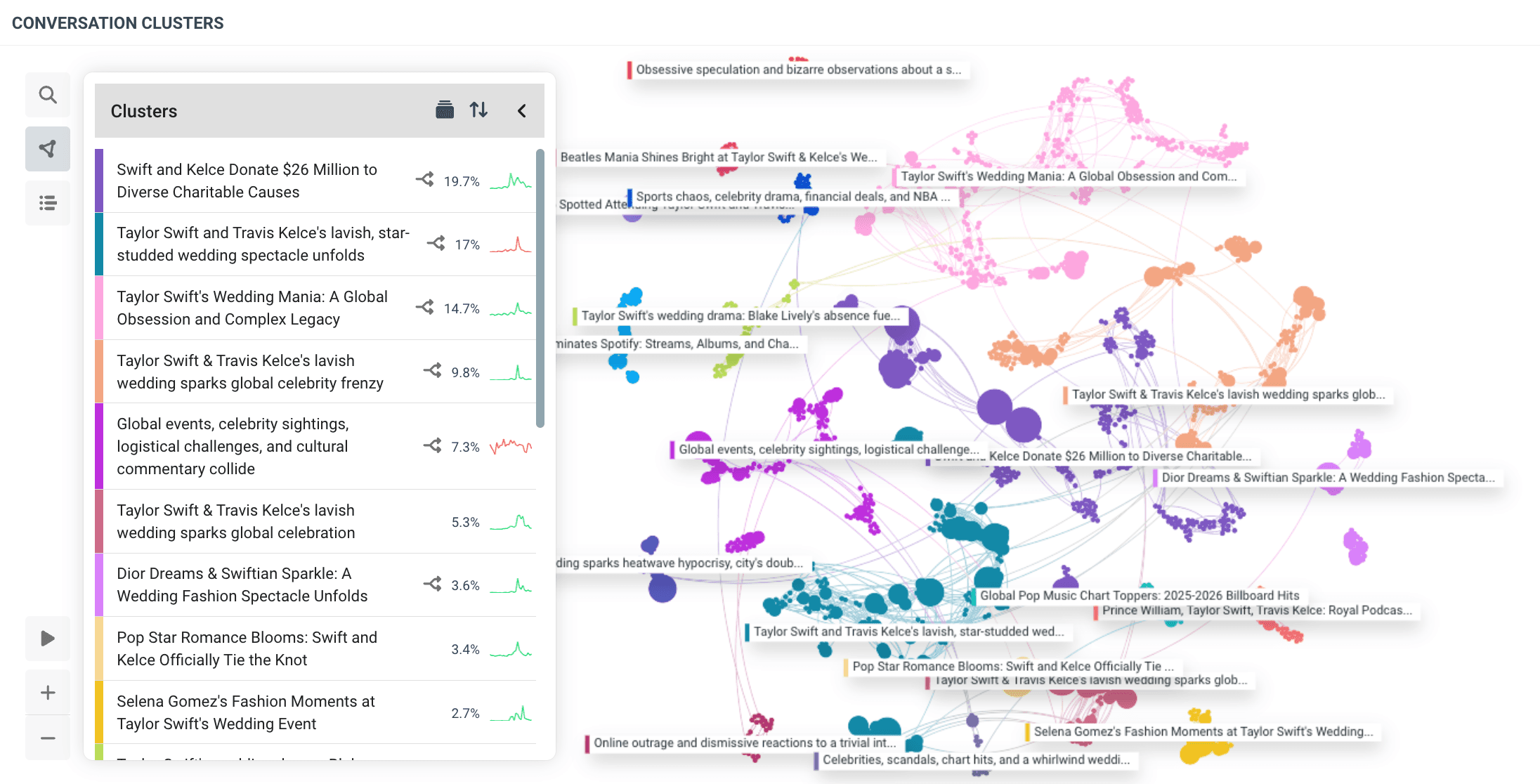
Cluster the posts by theme and the wedding's split personality shows up in the data itself. The largest single cluster, at 19.7% of clustered conversation, was the couple's $26 million charitable donation (more on that below). Below it, the clusters divide cleanly into celebration on one side and complexity on the other.
Conversation cluster | Share of clustered conversation |
Swift and Kelce donate $26 million to charitable causes | 19.7% |
Lavish, star-studded wedding spectacle unfolds | 17% |
Wedding mania: a global obsession and complex legacy | 14.7% |
Wedding sparks global celebrity frenzy | 9.8% |
Global events, celebrity sightings, and logistical challenges | 7.3% |
Wedding sparks global celebration | 5.3% |
Dior dreams and Swiftian sparkle: a fashion spectacle | 3.6% |
Pop star romance: Swift and Kelce officially tie the knot | 3.4% |
Selena Gomez's fashion moments at the wedding | 2.7% |
Blake Lively's absence fuels friendship-fallout speculation | 2.3% |
Taylor Swift dominates Spotify streams and charts | 2.2% |
Prince William, Swift, and Kelce: royal podcast buzz | 2.1% |
Wedding sparks heatwave-hypocrisy and double-standards debate | 1.6% |
Online outrage and dismissive reactions to internet controversy | 1.3% |
Source: Lumen by Talkwalker conversation clustering, June 30 – July 6, 2026. Shares reflect each cluster's portion of clustered conversation.
The celebratory clusters (the spectacle, the fashion, the romance, and the guest sightings) sit right beside sharper ones: “a global obsession and complex legacy,” “heatwave-hypocrisy and double standards,” and “online outrage.” Audiences celebrated and interrogated the wedding at the same time, and “complex legacy” is the data's own phrase, not the commentary's.
The $26 million counter-narrative
The biggest cluster deserves a closer look, because it is the clearest piece of strategy in the entire dataset.
Days before the wedding, Swift's publicist announced that the couple had donated $26 million across 20 charities in the United States. The organizations spanned nine food banks, three children's hospitals, seven education programs, and an animal-welfare group, concentrated in the cities where the two have roots: New York, Rhode Island, Kansas City, Nashville, and Swift's and Kelce's hometowns.
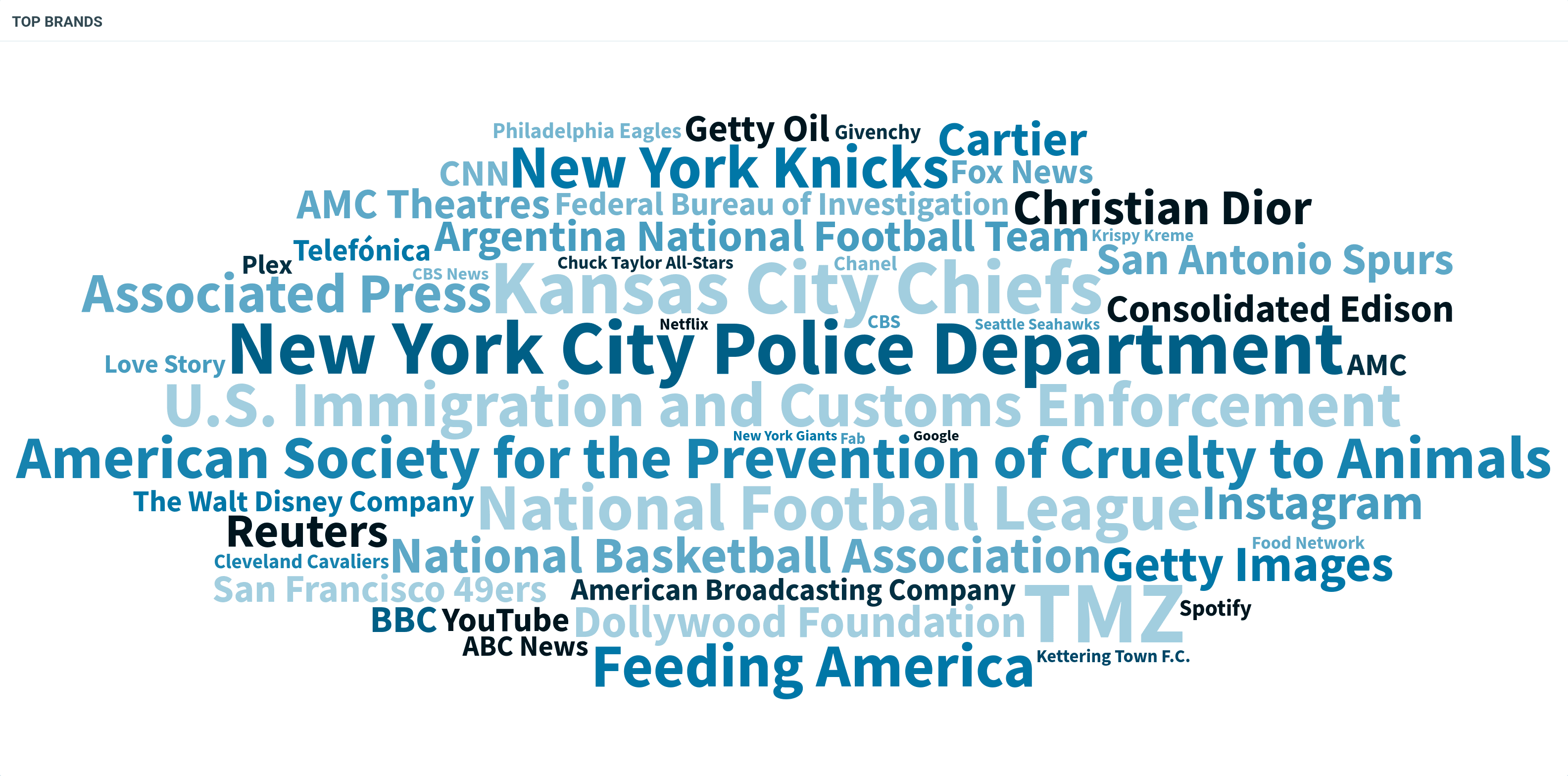
The named beneficiaries were prominent enough to surface in the wedding's own top-brands view. Feeding America, the ASPCA, and Dolly Parton's Imagination Library all appear alongside the media and sports names, joined by local recipients like City Harvest, Food Bank For NYC, Children's Mercy Hospital, and MSK Kids.
Source: Lumen by Talkwalker brand and organization detection, June 30 – July 6, 2026.
Parton publicly thanked the couple for a $2 million gift; City Harvest and the Rhode Island Community Food Bank each confirmed $1 million.
Here is the detail that made the story land: the donation reportedly exceeded the cost of the wedding itself, which luxury planners estimated at $15 million to $20 million. The announcement did not even mention the wedding. It stood on its own, and let everyone else connect the dots.
That is narrative control at its most efficient. Released into a moment of peak attention, the giving became the single loudest thread about the wedding and gave the celebration a built-in counterweight to the wealth-and-privilege criticism running underneath it. Audiences did not all read it the same way; the conversation held both genuine admiration and accusations of image management. But either way, it shaped the frame before the frame could be set for them.
Six lessons marketers can take from the most-watched wedding of the year
Strip away the celebrity, and the Swift-Kelce wedding is a near-perfect model of a high-stakes brand moment. Six lessons carry over to any organization planning a launch, event, or campaign built for scale.
1. Treat milestone moments as brand moments, on purpose.
Swift turned a personal event into a global one and released each beat on her own schedule. Brands can do the same with launches and anniversaries, provided the story genuinely fits their values and their audience.
2. Anticipate the backlash, especially when you touch the public.
The most negative sentiment did not attach to the couple. It attached to closed streets and disrupted plans, and it was concentrated in the United States and other English-speaking markets. If an activation inconveniences a real community, plan the communication for that before it becomes the story, and remember the same moment may play very differently in other regions.
3. Pair spectacle with substance.
The lavishness drew criticism as tone-deaf against a difficult economy, even with a large donation attached. Audiences increasingly expect visible success to come with visible responsibility, and they can tell the difference between the two.
4. Control the narrative, but know the price of secrecy.
NDAs and a locked-down venue let the couple set the timeline, and the neutral NDA sentiment shows most people accepted it. The negativity concentrated in the Leak topic is the bill for that control: a slice of the audience will always resent being shut out.
5. Mind the optics of inclusion and exclusion.
A rumored missing guest generated its own multi-day storyline. In high-visibility moments, who is in and who is out becomes public narrative, so relationship management is reputation management.
6. Listen in real time, because the story moves faster than you do.
This entire analysis is possible because the conversation was tracked as it happened, cluster by cluster, sentiment shift by sentiment shift. A social listening platform like Lumen by Talkwalker lets teams see where a moment is heading while there is still time to act, rather than reading the postmortem a week later.
The bottom line
Taylor Swift and Travis Kelce threw a wedding almost no one could see, and 5.6 million posts talked about it anyway. The couple proved you can control what people see. They also proved you cannot control that they will talk.
Want to see this kind of analysis for your own brand or the next cultural moment? Explore social listening with Lumen by Talkwalker. Book a free demo today.