Trend insights
FIFA World Cup 2026 in data: What 47 million conversations reveal
We tracked the FIFA World Cup 2026 conversation: audience demographics, sponsor share of voice, sentiment, and the brands winning attention.
July 21, 2026
- Methodology
- The shape of the conversation
- Who was actually watching
- Where the mood turned
- The final: Spain, Argentina, and a farewell
- The halftime show stole the demographic prize
- Creators became their own broadcast channel
- How brands played the tournament
- Track the next big moment in real time
- See what your audience is saying
The FIFA World Cup 2026 tournament is over. Here's what the full run of the data says about the audience, the sentiment, and the brands that actually broke through, off the pitch as much as on it.
The first 48-team World Cup, co-hosted by the United States, Canada, and Mexico, was always going to be big. What the social data shows is how big, and how much of the conversation happened away from the scoreline.
Between June 11 and July 20, 2026, Lumen by Talkwalker tracked more than 47 million mentions of the tournament across social platforms, news, and online media.
Spain beat Argentina in the final on July 19, but the number that matters most for marketers isn't the score. It's the audience that cared about it: young, globally distributed, and entertainment hungry; one that brands reached most effectively when football shared the stage with music, celebrity, and spectacle rather than competing with it.
Methodology
We used Lumen by Talkwalker to track how audiences, publishers, and creators across 150+ million sources talked about World Cup 2026 between June 11 and July 20. We measured conversation volume, sentiment, and the theme clusters forming around the tournament and its sponsors.
You can run the same analysis on your own brand, competitors, or category. Book a free Lumen demo today.
Definitions
Share of reach measures the proportion of the total potential audience that a topic is exposed to within a defined subject area. It focuses on how many unique users could have seen content from a specific category.
Share of topic measures the proportion of total conversations or mentions about a specific topic. It focuses on how much the topic is being talked about within a defined subject area.
Share of engagement measures the proportion of total interactions (likes, comments, shares, retweets, and reactions) that a topic receives within a defined subject area.
Age, gender, and country figures are modeled from author profile data and cover only the subset of authors for whom that data is available, a smaller base than the full mention count.
Want to explore emerging conversations yourself? Try this free trend tracker to discover trending topics, hashtags, and conversations in real time.
The shape of the conversation
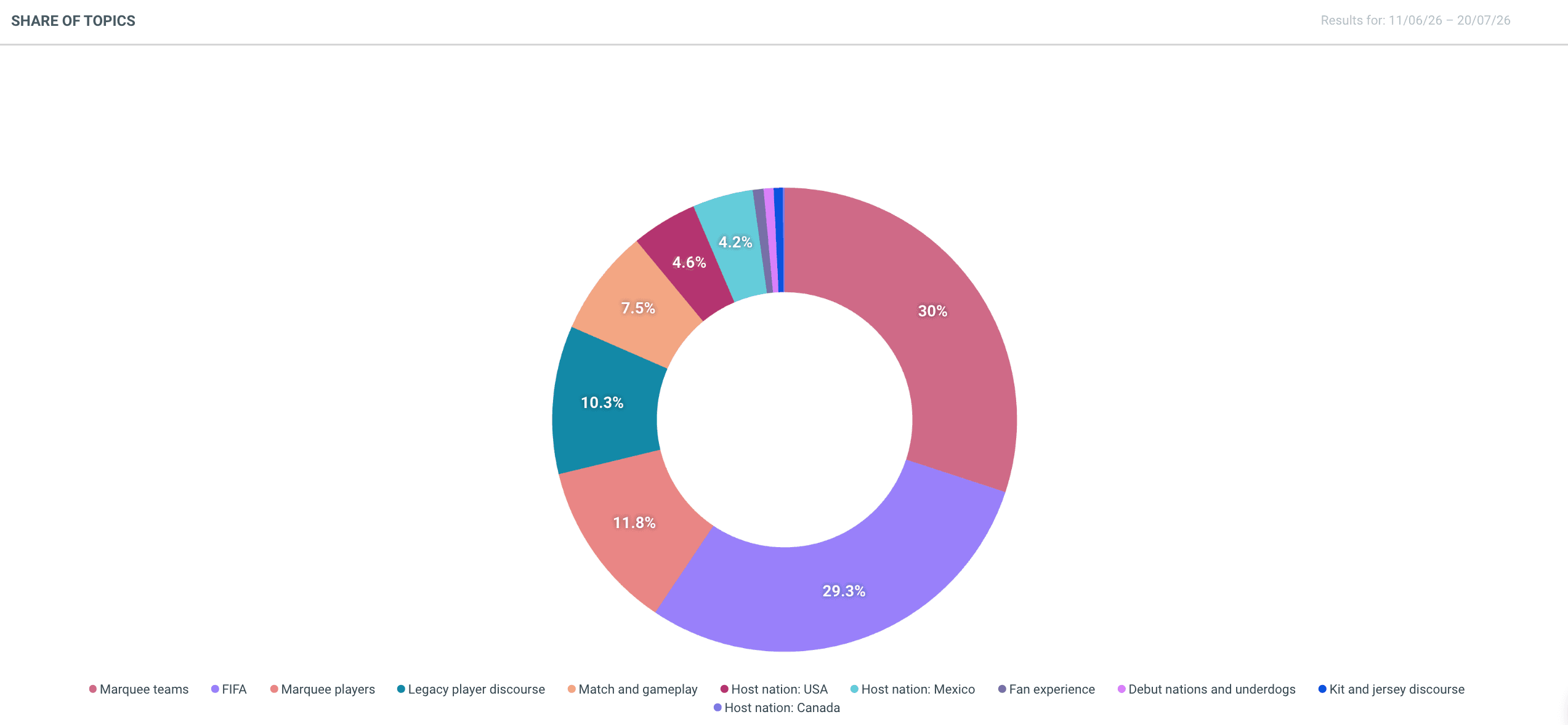
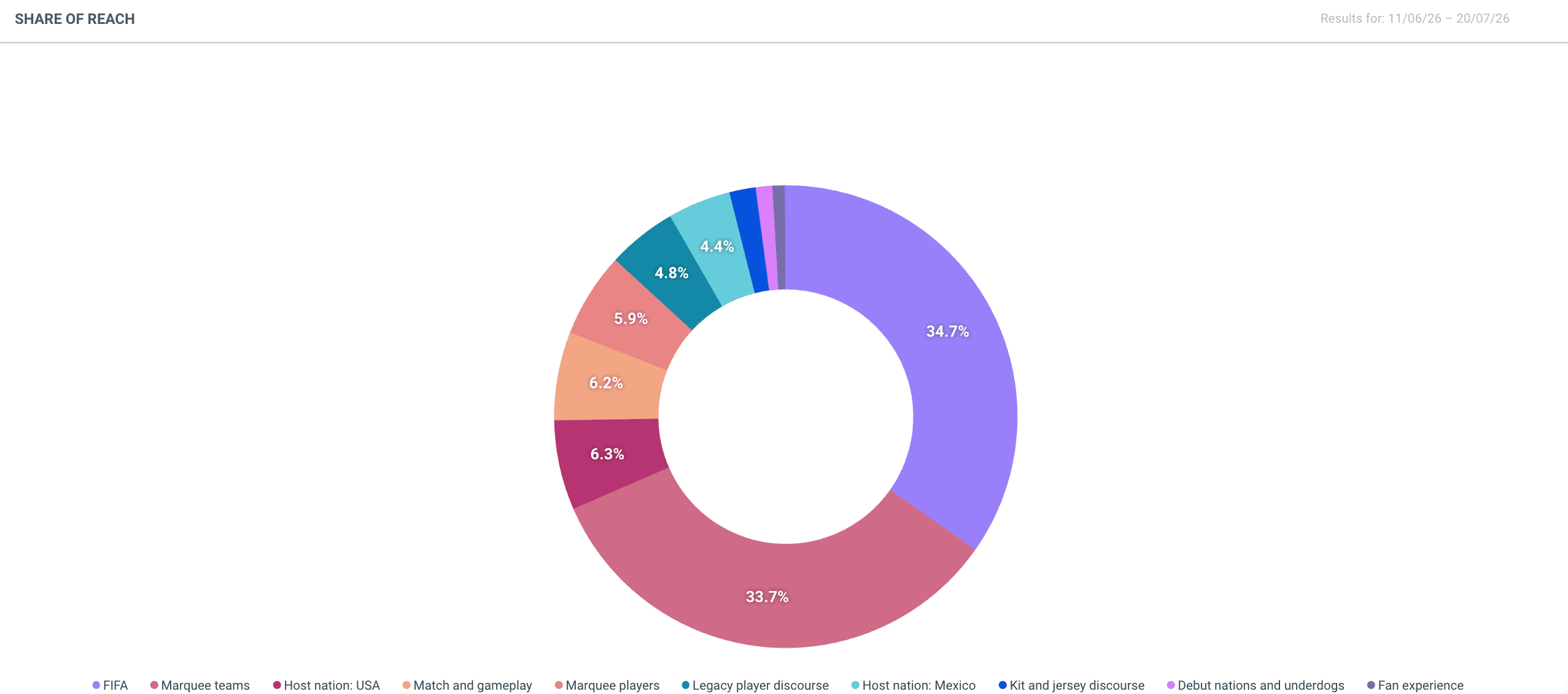
Two topics dominated the full run of the tournament: marquee national teams and FIFA itself.
Marquee teams drove 30% of all tournament mentions and FIFA 29.3%, together close to 60% of the conversation.
Source: Lumen by Talkwalker
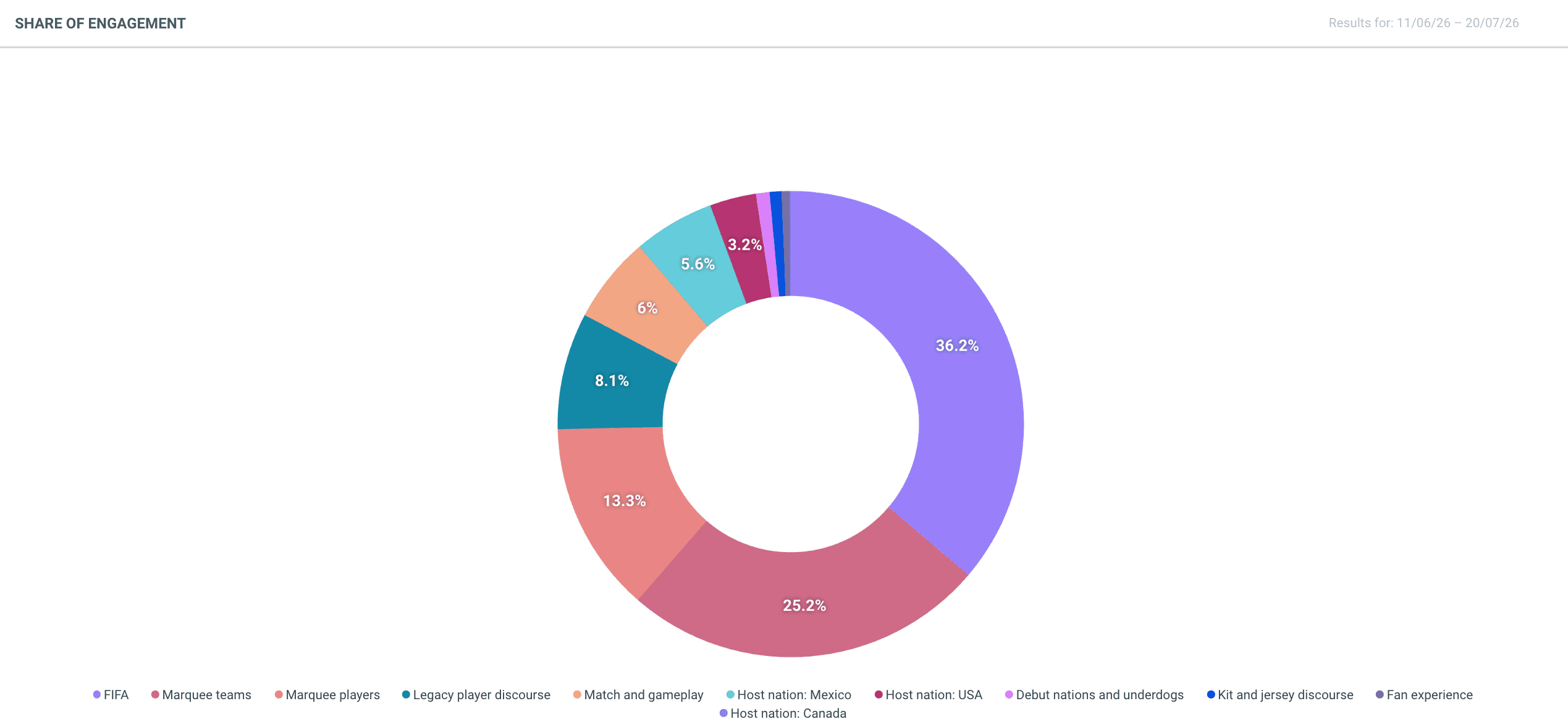
Volume and influence aren't the same thing, though. FIFA led on both engagement (36.2%) and potential reach (34.7%), while marquee teams generated more raw posts than interactions, a sign that institutional and news-led content traveled further per post than fan chatter did.
Source: Lumen by Talkwalker
Source: Lumen by Talkwalker
Marquee players were the third pillar, at 11.8% of mentions but a larger 13.3% of engagement. That gap between volume and engagement is the same signal our two-week check-in picked up early: individual stars, not just teams, carry the tournament's social weight, and they carry it more efficiently than institutions do.
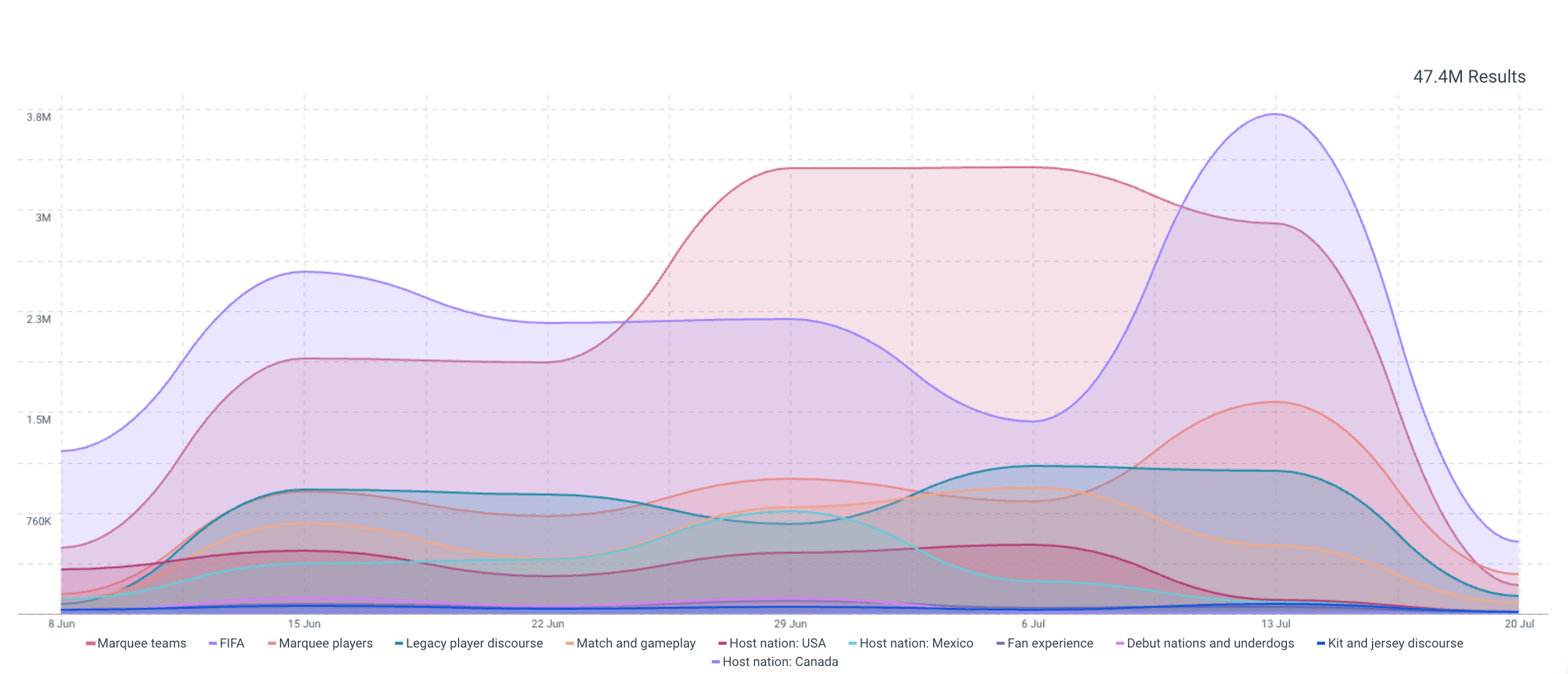
Volume built steadily through the group stage, rose sharply around the host-nation storylines in late June and early July, and peaked in the week of the final. The United States, as host, drew its own sustained wave of attention that ran somewhat independent of how the U.S. team actually performed on the pitch.
Source: Lumen by Talkwalker
Takeaway for marketers
Conversation volume tells you where the crowd is standing. Engagement and reach tell you where the crowd is actually listening. For sponsors choosing where to spend attention, the second pair of numbers is the one to plan against.
Who was actually watching
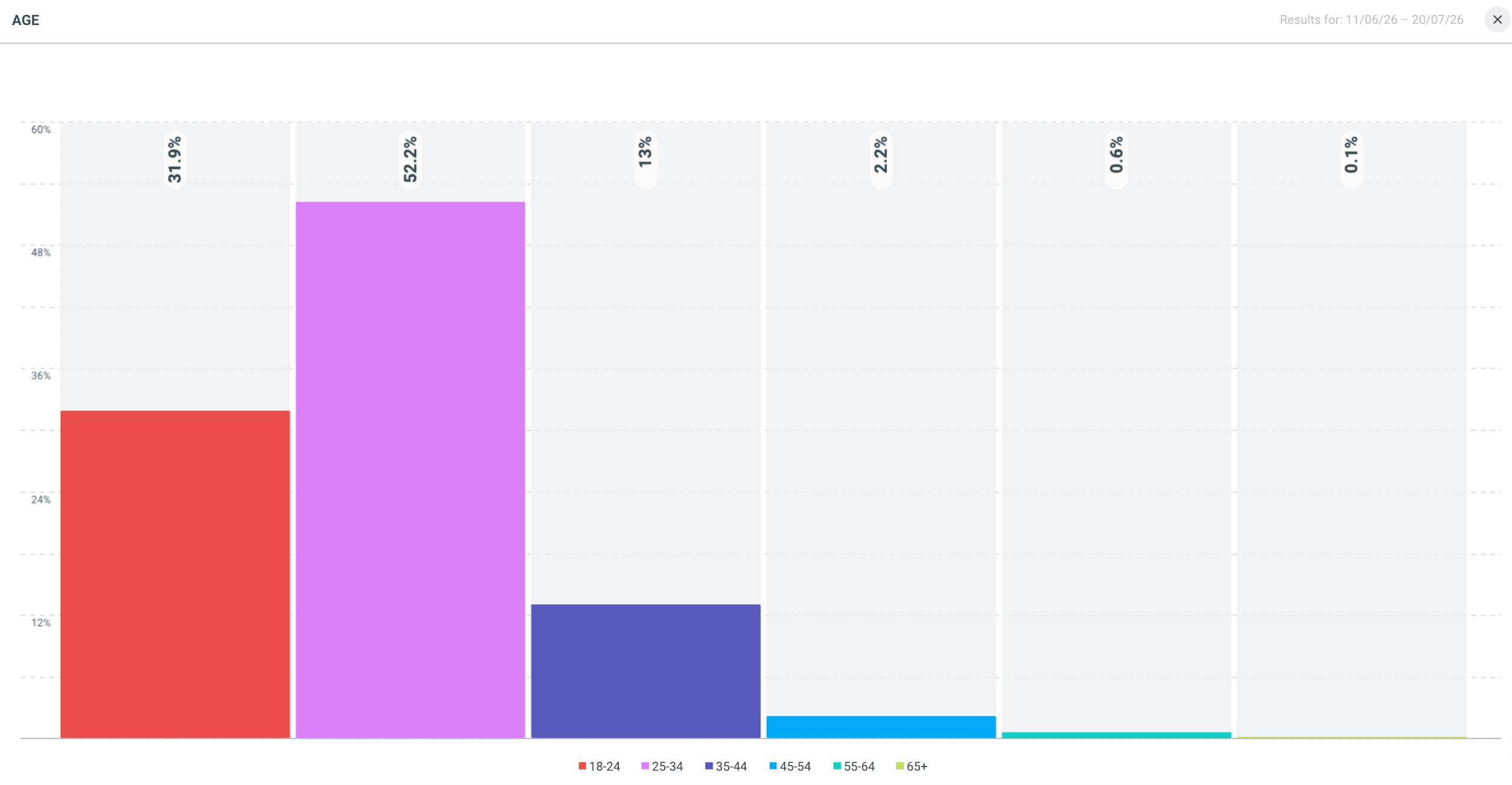
The online audience skewed young and male throughout. More than 8 in 10 participants were under 35 (52.2% aged 25 to 34, 31.9% aged 18 to 24), and participation fell off sharply after 44.
Source: Lumen by Talkwalker
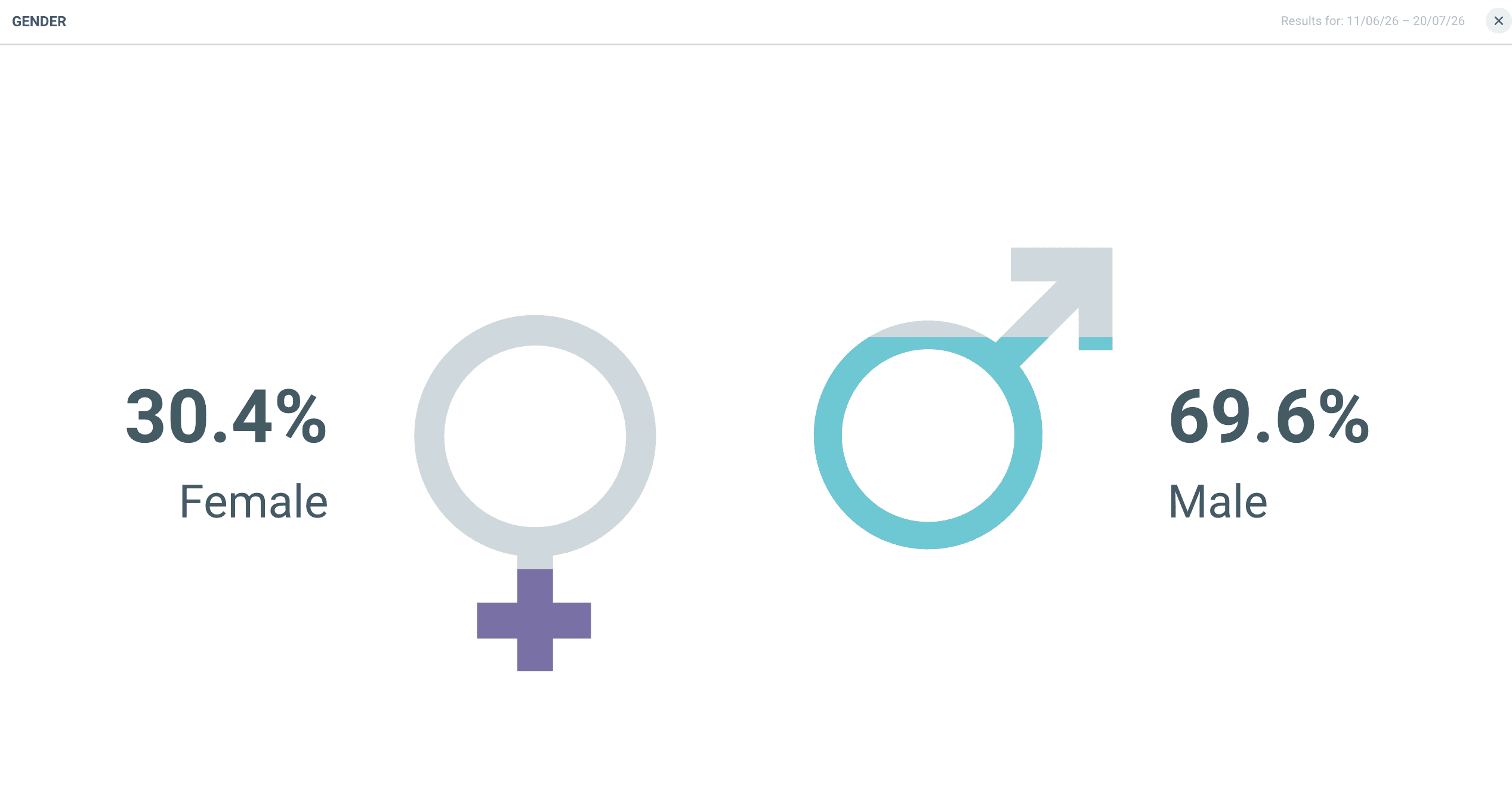
Men made up 69.6% of the audience, women 30.4%.
Source: Lumen by Talkwalker
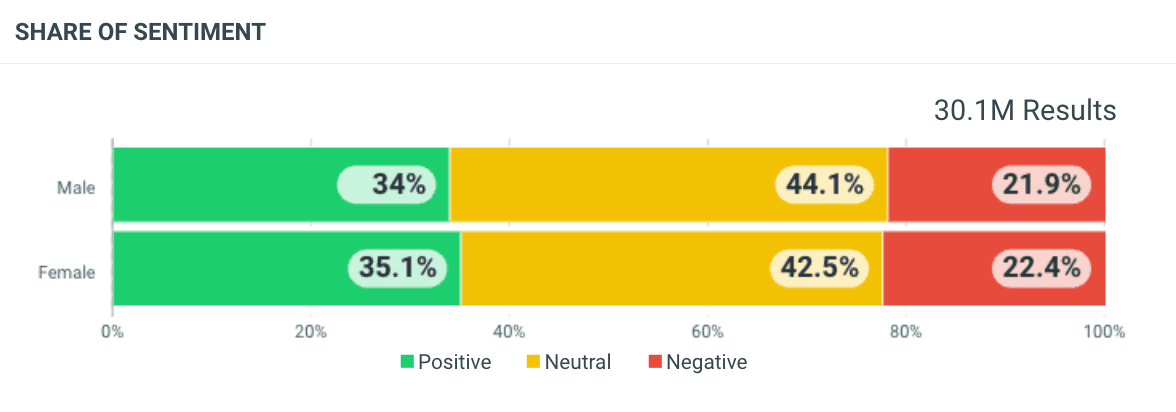
The gender split matters less for mood than you'd expect. Sentiment ran almost identical across men and women (34% positive for men, 35.1% for women), which means the opportunity in the 30.4% female share is about reach, not persuasion.
Source: Lumen by Talkwalker
Female engagement was led by the United States by a wide margin, followed by South Korea, Colombia, India, and Spain, an early signal that entertainment and star-driven storylines pulled audiences in from markets without a team deep in the tournament. That pattern becomes the whole story later on, when the halftime show reshapes the audience entirely.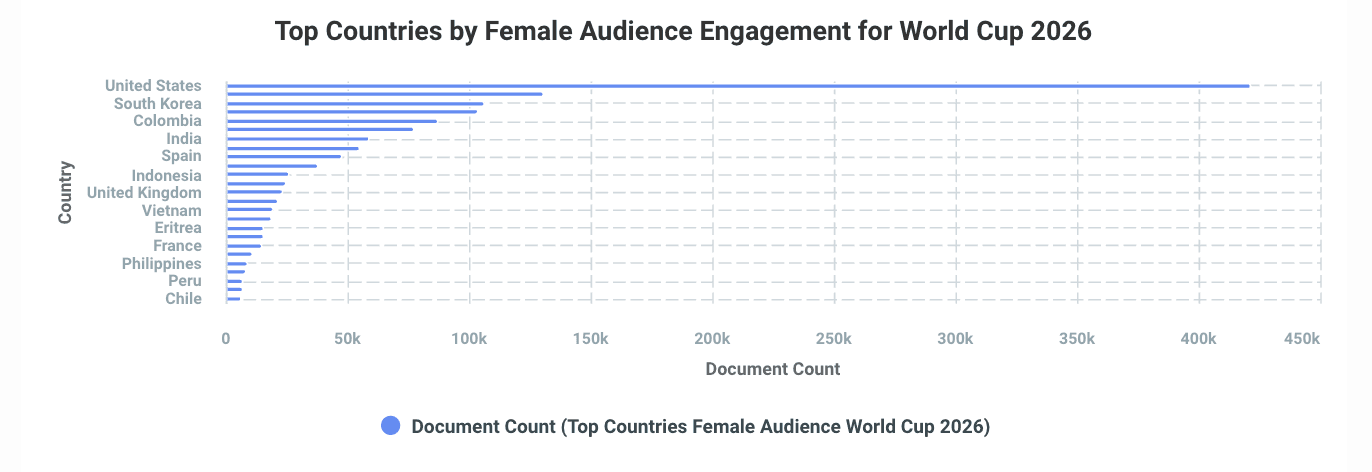
Source: Lumen by Talkwalker
One host nation's sentiment moved more than any other over the course of the tournament. The United States drew sharply polarized reactions early on, but by the final whistle its net sentiment had settled to just above break-even (+2.3%), the coolest of any host nation but no longer the lightning rod it looked like at the tournament’s two-week mark.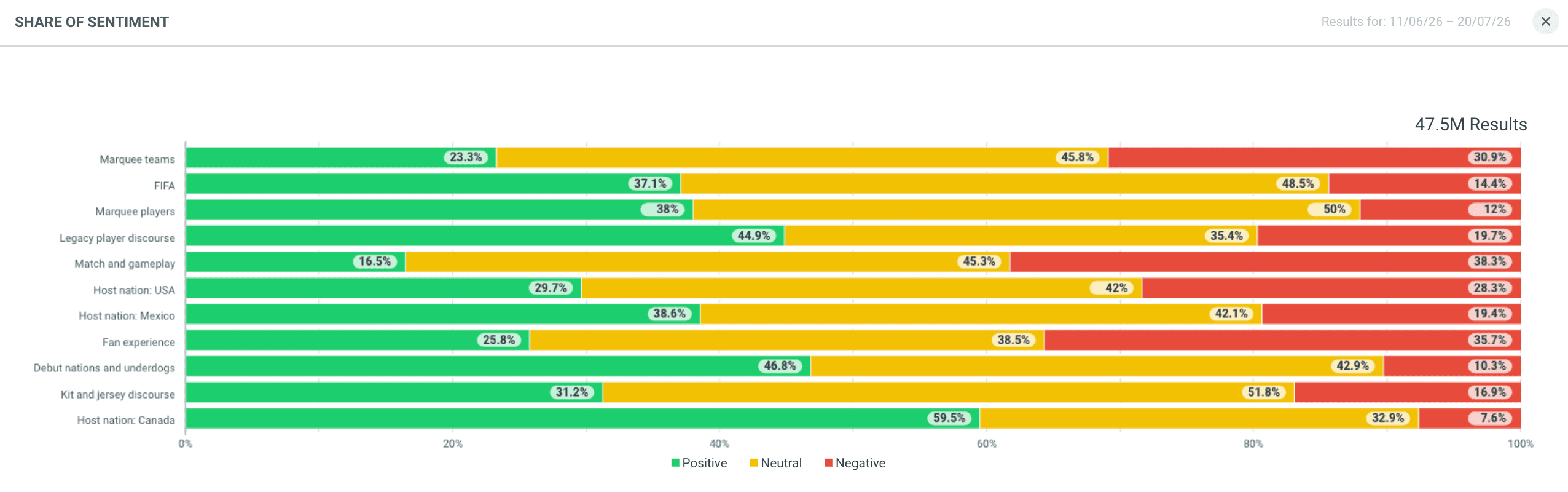
Source: Lumen by Talkwalker
Takeaway for marketers
With over 80% of the audience under 35, mobile-first, short-form, creator-led content isn't an experiment anymore. It's the baseline plan.
Where the mood turned
Net sentiment by topic tells a clean story about what fans loved and what wore on them. The warmest conversations were about underdogs and the smallest host nation: debut nations and underdogs posted +64% net sentiment, and host nation Canada ran +77%, the single most positive topic in the entire dataset. Marquee players (+52%) and FIFA as an institution (+44%) also ran strongly positive.
The negativity concentrated in two places. Match and gameplay was the most negative topic at -40% net sentiment, much of it tied to officiating and VAR decisions, and marquee teams sat at -14%, the familiar pattern of high expectations meeting real-time disappointment. Fan experience ran net negative too, at -16%, and the texture behind that number is worth pulling apart.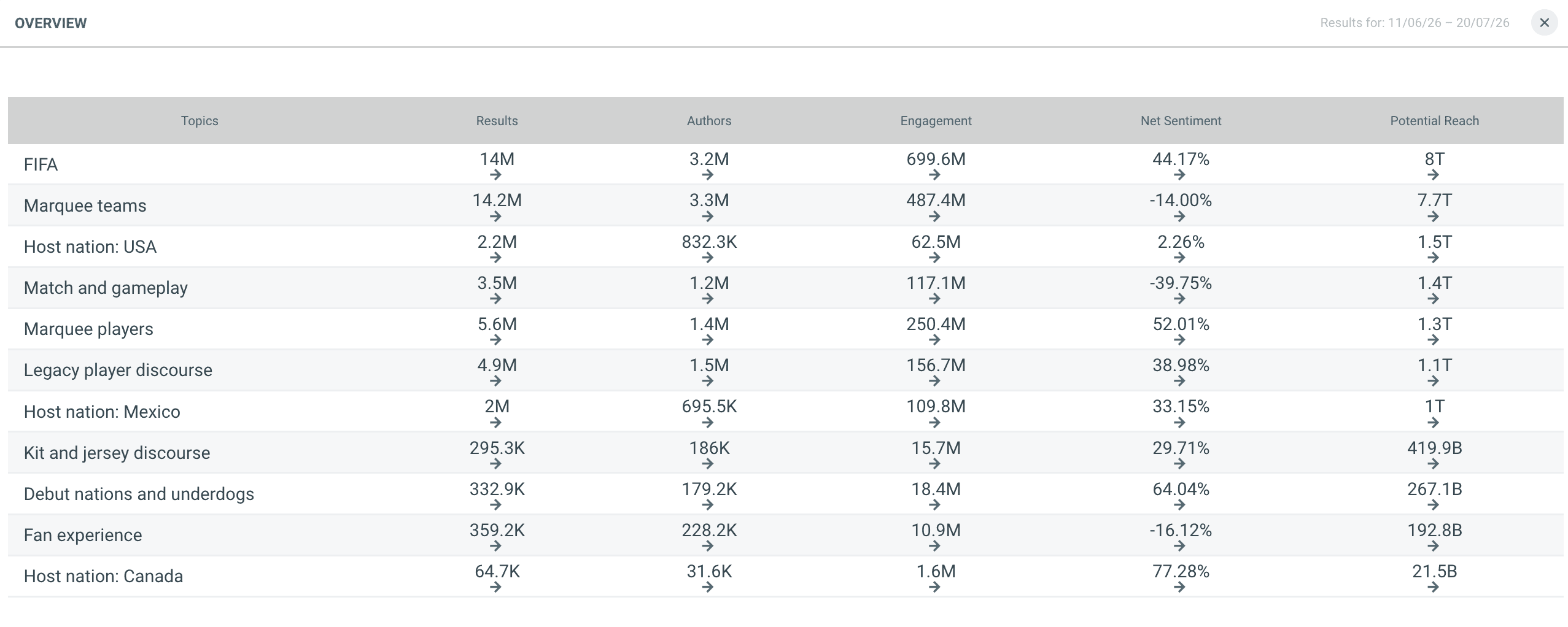
Source: Lumen by Talkwalker
A chunk of it traces back to a stadium policy: a since-reversed cap on refillable water bottles, introduced during a stretch of extreme heat early in the tournament. Fans read the reversal as an admission that the original policy protected the tournament's beverage sponsor at their expense, and that read followed FIFA into every subsequent conversation about hydration breaks, which carried sponsor messaging of their own. It's the clearest example in the whole dataset of a commercial decision curdling into a fan-experience complaint, and it's the kind of story a brand doesn't want its name anywhere near.
Takeaway for marketers
The warmth in this tournament belongs to people, not policy. Underdogs, hosts, and players run positive; institutions and logistics run cooler. When a commercial call reads as anti-fan, the frustration doesn't stay contained to the decision. It spreads to whatever sponsor is standing closest.
The final: Spain, Argentina, and a farewell
The final week alone generated 26.9 million mentions. Spain won 1-0 after extra time, with substitute Ferran Torres converting a Nico Williams assist less than a minute into the second period of extra time, following a second-half red card to Argentina's Enzo Fernández. Emiliano Martínez set a World Cup final record with his save count keeping Argentina in the game as long as he did. It was Spain's second World Cup title, following their win in 2010, and the presumed end of Lionel Messi's international career.
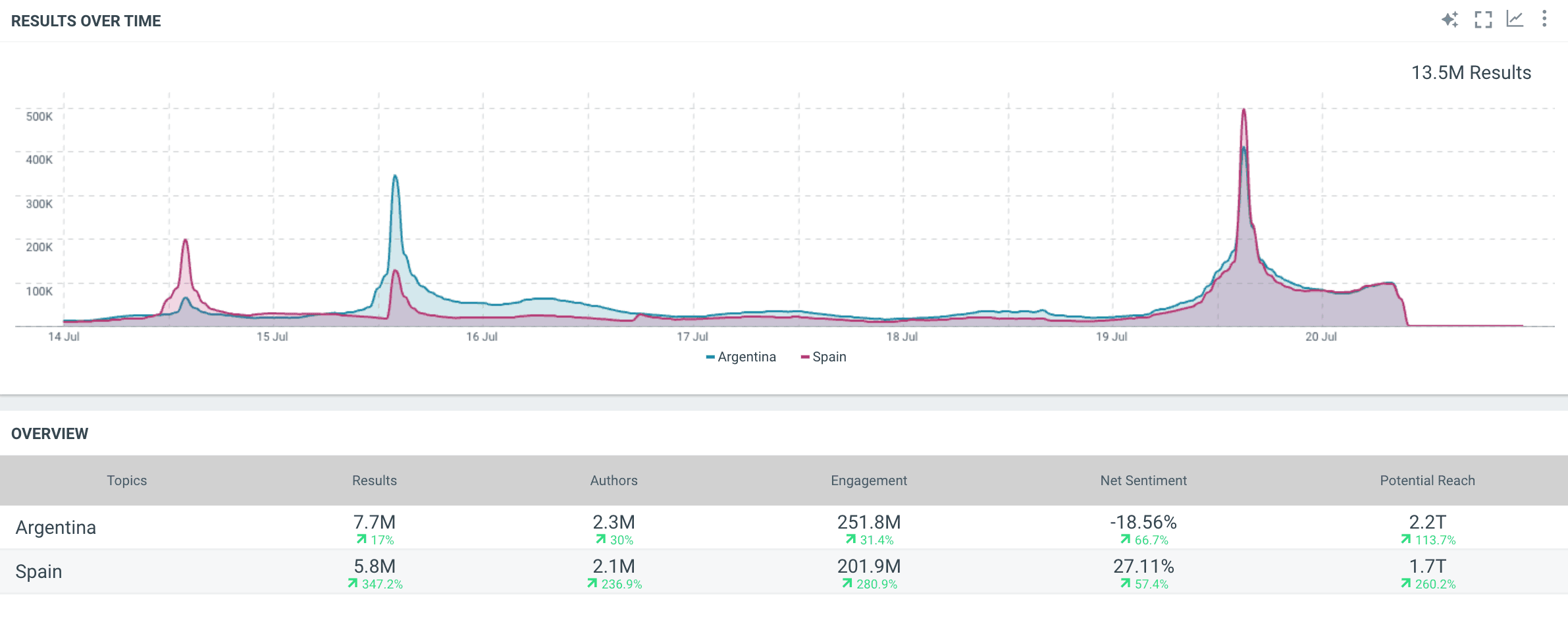
The data around the two sides diverged sharply along the lines you'd expect from a winner and a loser, but the gap was unusually wide. Spain closed the tournament at +27% net sentiment; Argentina at -18%, with Argentina drawing 34% negative mentions against Spain's 21%.
Source: Lumen by Talkwalker
Argentina still out-volumed Spain in raw mentions (7.7 million to 5.8 million) and even in engagement (251.8 million to 201.9 million), carried in large part by the emotional weight of Messi's likely farewell tournament, while Spain's numbers surged behind a young squad built around players like Lamine Yamal.
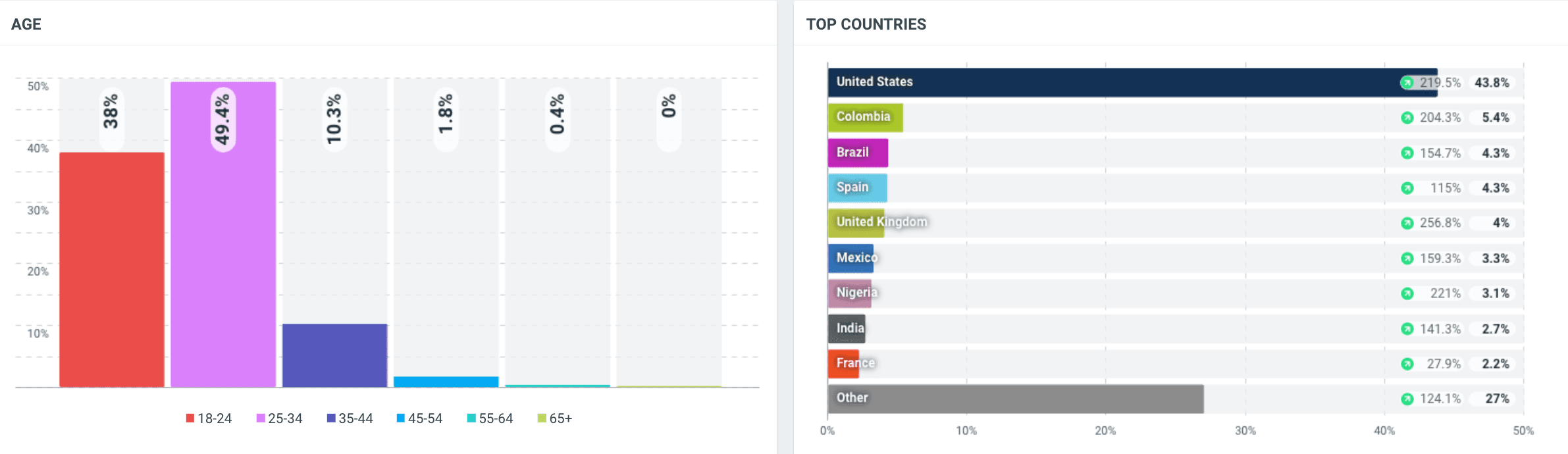
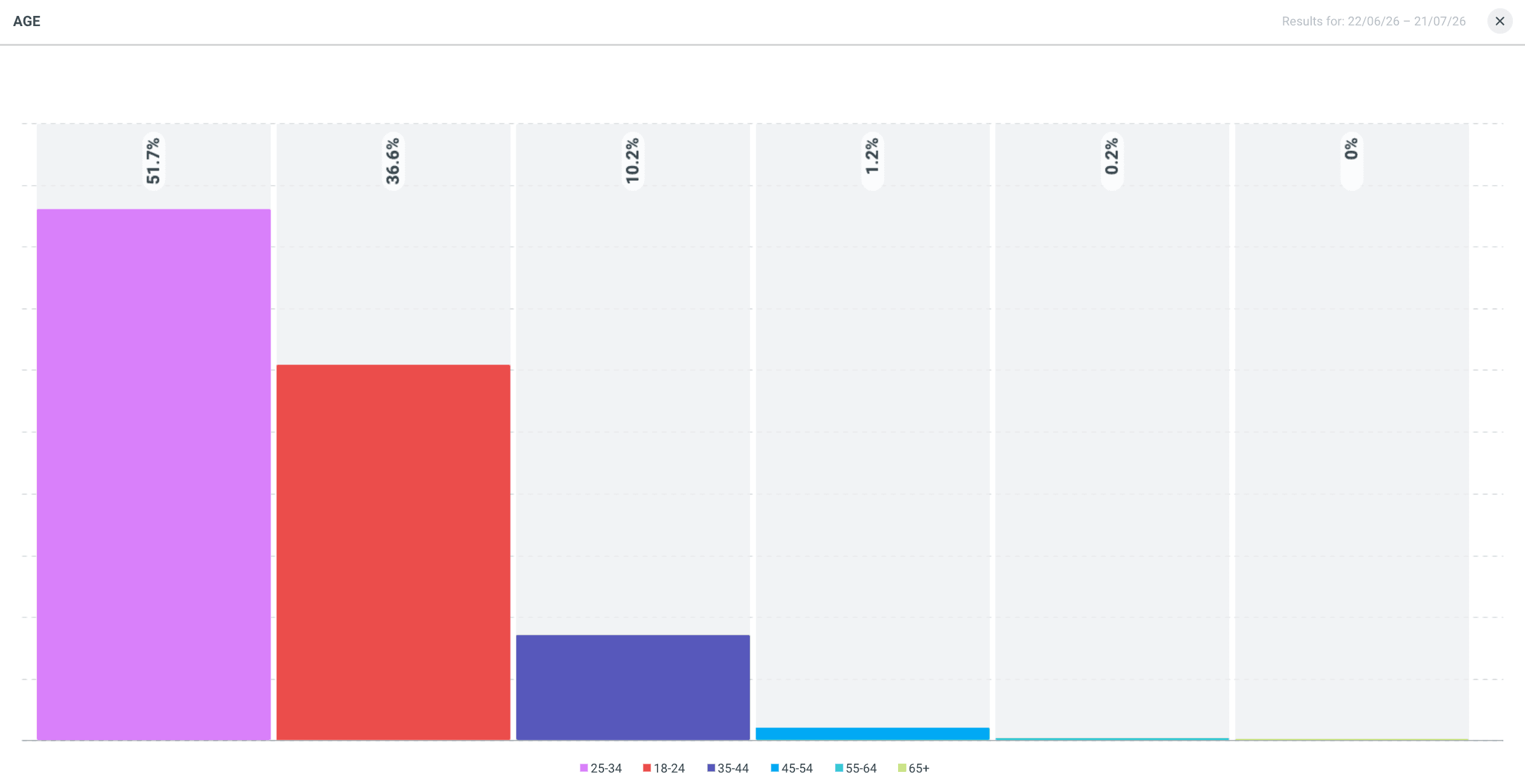
Both audiences looked similar demographically: roughly two-thirds male, and about 52% aged 25 to 34 on each side.

Source: Lumen by Talkwalker
Source: Lumen by Talkwalker
Takeaway for marketers
A final doesn't just produce a winner and a loser in the data. It produces two entirely different emotional environments running in parallel, and a brand attached to the losing side inherits a very different conversation than one attached to the winner, regardless of how good the campaign was.
The halftime show stole the demographic prize
The most interesting marketing story of the tournament wasn't a sponsor. It was the first-ever World Cup final halftime show, an 11-minute production co-headlined by Madonna, Justin Bieber, BTS, and Shakira with Burna Boy, curated by Coldplay's Chris Martin in support of the FIFA Global Citizen Education Fund. Shakira and Burna Boy performed "Dai Dai," the tournament's official song, and the closing ceremony that followed the final added its own lineup, including Jennifer Hudson, Robbie Williams, Laura Pausini, Nicole Scherzinger, and a speech from Tom Cruise.
The halftime show reached an audience the football itself never touched. Conversation about it skewed 57.5% to the 18-24 group and 52.1% female, close to a mirror image of the tournament's overall male, 25-34 profile.

Source: Lumen by Talkwalker
The country mix shifted too: the United States led at 36.2%, but South Korea (8.5%), Brazil (8.3%), and Colombia (7.1%) all punched well above their tournament weight, following the artists rather than the teams.
Source: Lumen by Talkwalker
Sentiment followed the audience shift. The halftime show ran 49.9% positive with almost no negativity, under 5%, the cleanest sentiment profile of any single moment in the tournament. The closing ceremony, by contrast, skewed older and more male (60.9% male) and drew noticeably more criticism, close to 15% negative.

Source: Lumen by Talkwalker
This wasn't a one-off. The opening ceremony three weeks earlier had already run the same play at tournament scale, splitting itself into a 3-city trilogy across Mexico City, Toronto, and Los Angeles, with Lisa of Blackpink headlining as the first female K-pop soloist to open a World Cup. That set alone formed its own conversation cluster worth 6% of the entire FIFA topic. Bookended by an opening act built for younger, more global reach and a halftime show that repeated the trick at an even bigger scale, music did more to diversify this tournament's audience than any single football storyline did.
Takeaway for marketers
Entertainment moments unlock audiences the sport alone can't reach. A brand trying to reach young women in Seoul or Bogotá got more out of the halftime stage than it would from a shirt-front logo, and that gap shows up clearly in the numbers, not just in impressions.
Creators became their own broadcast channel
The clearest sign that this tournament ran on a parallel track to the football: a streamer got a slot at the closing ceremony.
IShowSpeed became the first content creator to perform at a World Cup final closing ceremony, delivering his viral football anthem "Champions" to a stadium and broadcast audience, on the same bill as Jennifer Hudson, Robbie Williams, Laura Pausini, and Nicole Scherzinger.
In the month leading up to the tournament’s closing ceremony, the streamer racked up an impressive 410K mentions in the context of his involvement with FIFA, generating over 46 million engagements.

Source: Lumen by Talkwalker
His performance was a clear nod towards the same young male demographic who make up the bulk of his online audience.
Source: Lumen by Talkwalker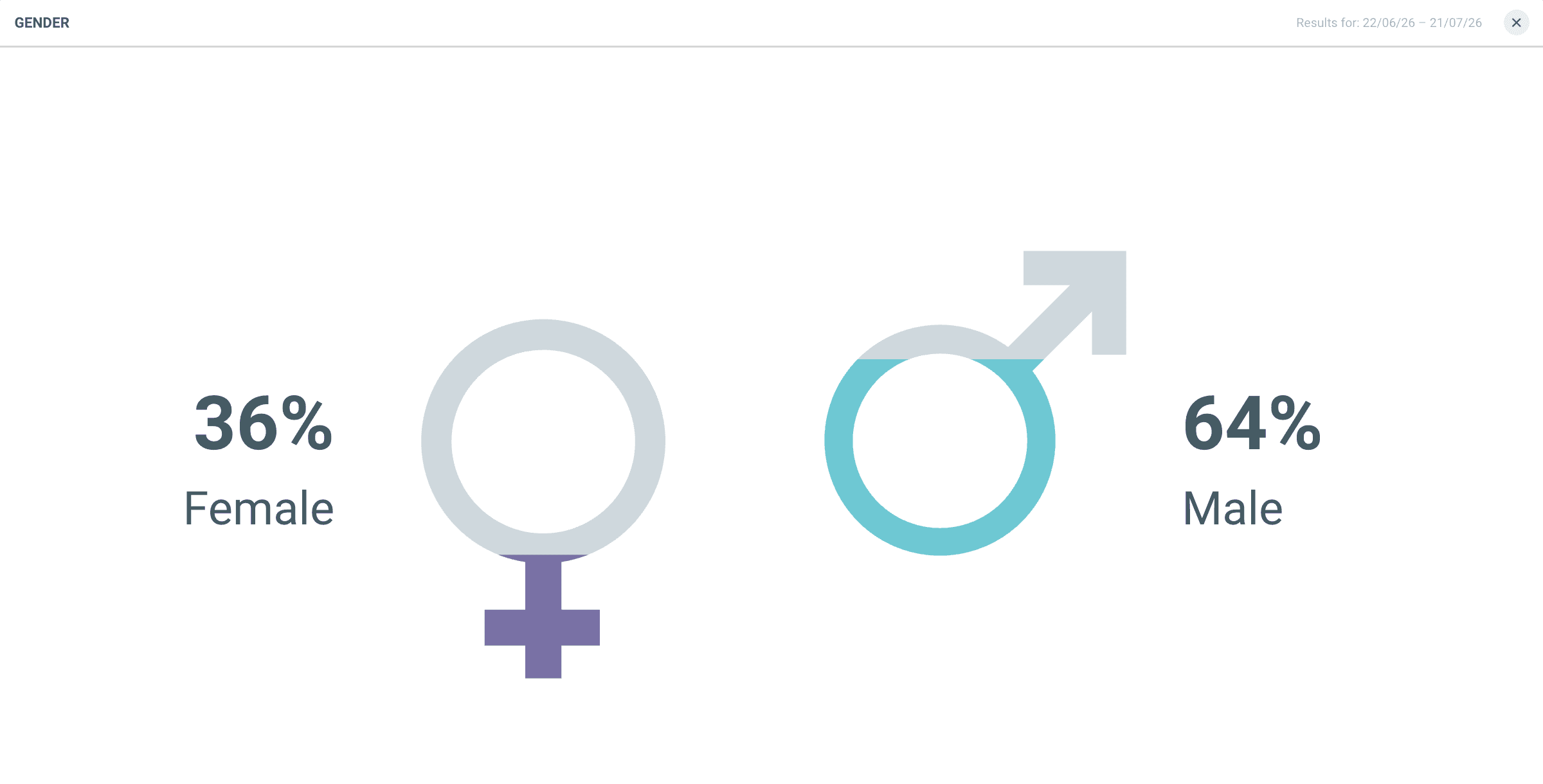
Source: Lumen by Talkwalker
Brands followed the same shift, moving away from one-off influencer posts toward sustained, multi-city creator campaigns that turned individual matches into standalone social events.
Visa and Rexona were among the sponsors building entire activations around creator content rather than treating creators as an add-on to a traditional ad buy, which fits the pattern the rest of this piece keeps surfacing: the moments that worked hardest were the ones built for a feed, not just for a broadcast.
Visa's “Tap In” campaign leaned on the same idea from the official-sponsor side. A physical Tap In Studio at select stadiums and host cities let attendees step into the campaign themselves, turning everyday fans into a source of footage the brand could reuse across its own channels, rather than relying only on a shot list from a studio.
At the same time, Visa paired that grassroots layer with familiar faces: actor Jason Sudeikis, playing a version of himself rather than his Ted Lasso character, fronted a series of spots traveling across the three host countries, appearing alongside Lamine Yamal, Erling Haaland, Christian Pulisic, Jorge Campos, and announcer Andrés Cantor.
The campaign ran across broadcast, digital, social, and creator partnerships at once, pairing scalable, authentic fan content with a polished celebrity thread, rather than treating either as the lead.
Takeaway for marketers
Creators are now co-authors of how a major event gets told, not a distribution add-on. That earns them a seat in campaign planning earlier than most brands currently give them, but it also means budgeting for accreditation and visa compliance alongside the content plan, especially for events that pull in creators from outside the host country.
How brands played the tournament
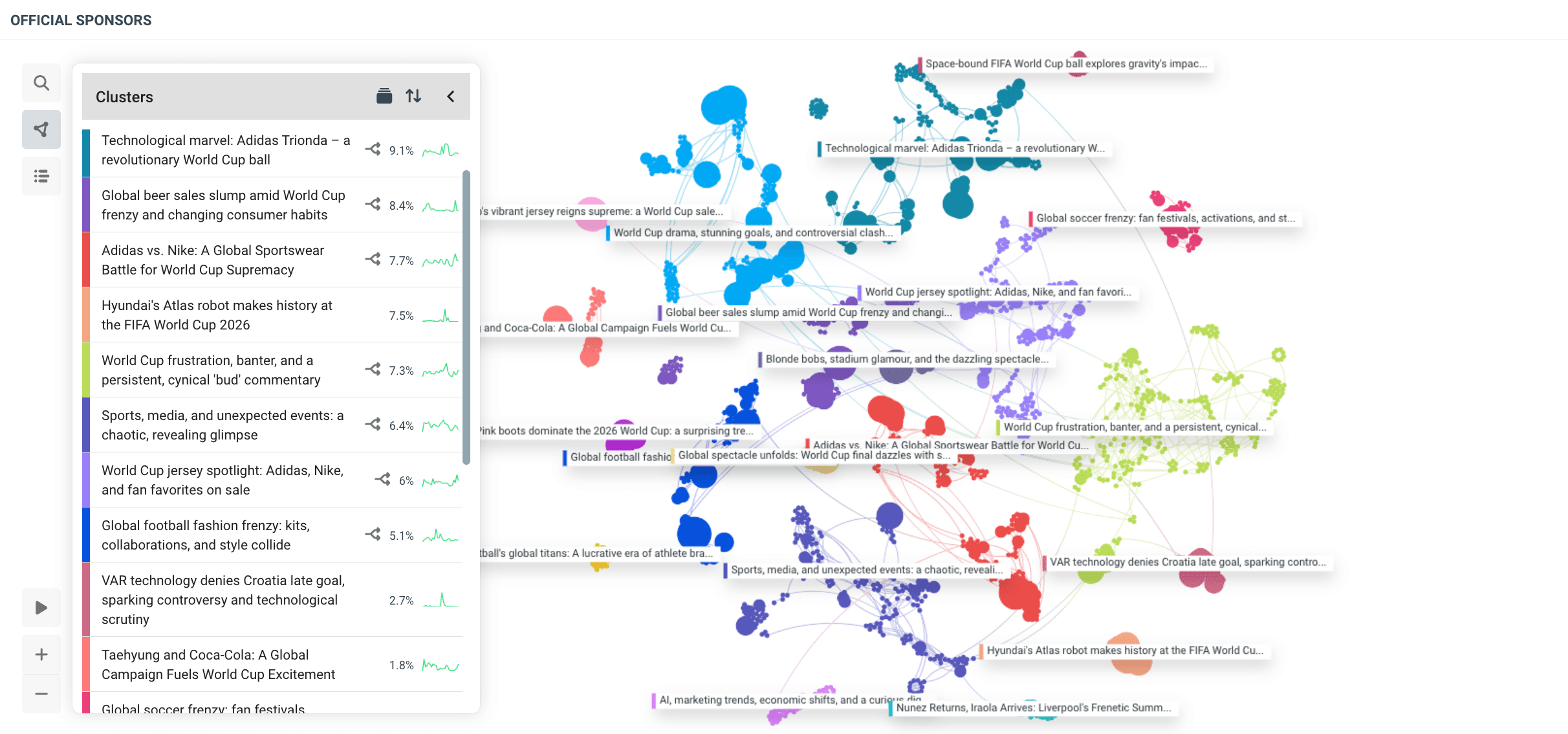
Brand activity split cleanly into two lanes: the official contest that rights holders paid for, and the unofficial scramble that happened around it. The second lane, consistently, produced the more memorable stories.
Source: Lumen by Talkwalker
The official contest
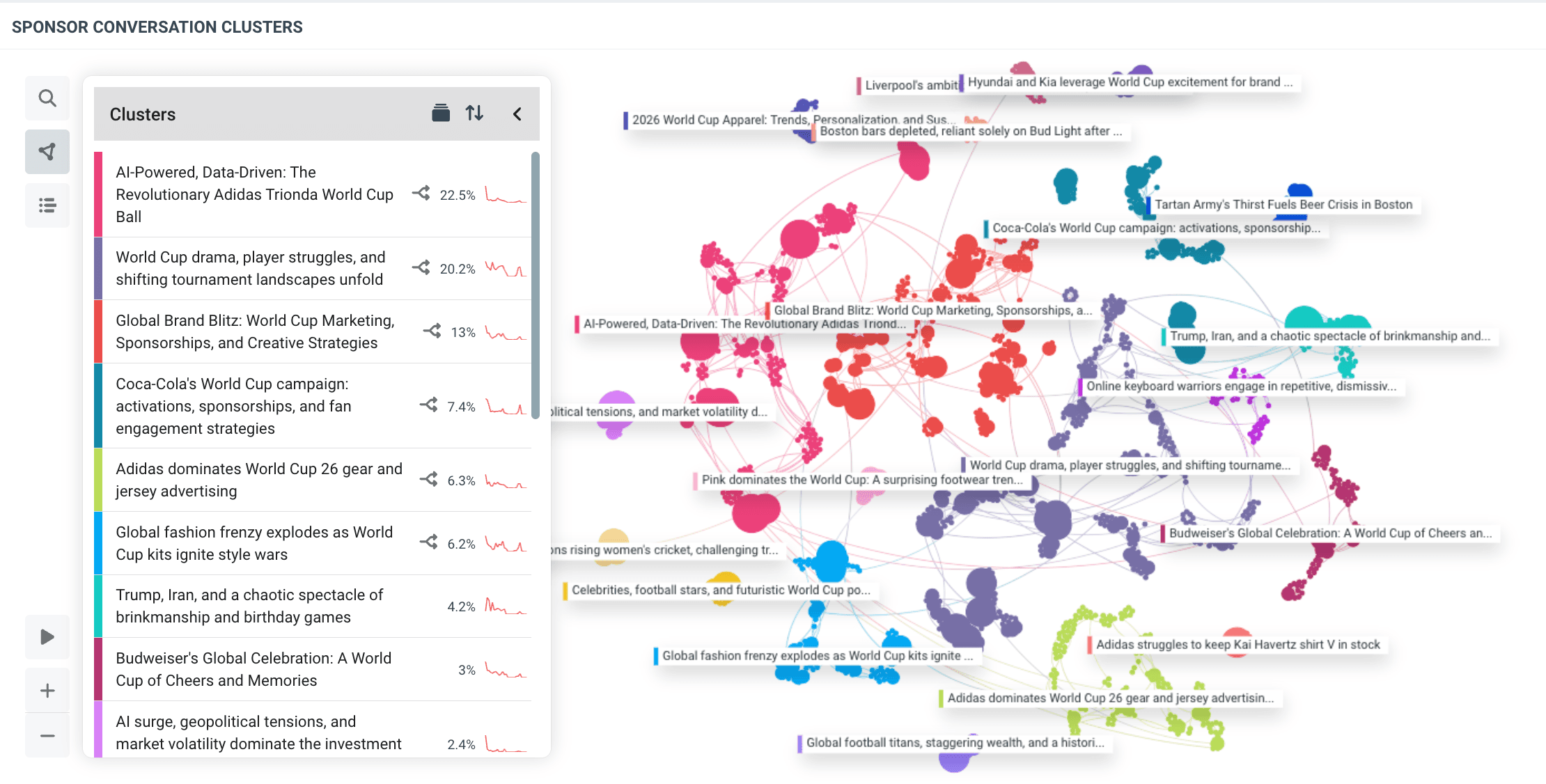
Adidas turned in the deepest brand performance of the tournament, and it did so by showing up in more than one place at once. The Trionda match ball anchored the product story, a redesigned tournament trophy added a design angle, and the Pass the Flame campaign, built around a deliberately cross-cultural cast (Son Heung-min and Lee Kang-in alongside Stray Kids' Felix as a "cheer captain," plus Lionel Messi and Bad Bunny), turned the same brand into a culture story as well.
Nike ran the more conventional kit-and-jersey battle against them.
Coca-Cola took the same cross-cultural approach in a narrower lane, running a campaign featuring Kim Taehyung of BTS that gained real traction across Asia.
It's the same playbook Adidas and FIFA both used: attach to a fandom that runs parallel to football, not inside it, to reach a demographic slice the core football audience doesn't cover.
Budweiser's global celebration campaign held its own single-digit share, and Meta rolled out World Cup features across WhatsApp that surfaced in the conversation without needing paid amplification. Elsewhere, Hyundai drew attention with an Atlas robot activation, and a thread about a category-wide beer sales slump during the tournament traveled nearly as far as any single campaign, a reminder that consumption stories can outrun marketing stories.
Source: Lumen by Talkwalker
A theme with no official sponsor tag at all ran alongside these: crypto brands worked their way into the conversation by partnering directly with national federations and by launching fan-engagement tools and prediction markets tied to matches, alongside chatter about digital collectibles and a rumored tournament-branded coin. It stayed small next to the tournament's biggest clusters, but it was unusually persistent for a story with no sponsor badge behind it. Share of voice, this tournament proved again, doesn't require one.
The ambush and the unofficial playbook
The most creative work of the tournament came from brands without any official standing at all.
Levi's and Heinz ran into the same rule and found each other on the other side of it. FIFA's clean-venue policy required non-official brands to have logos and products covered inside stadiums, which meant Heinz ketchup bottles turned up with black tape over the label at concession stands. Levi's branding got concealed on apparel worn inside the venue that carries its own name, Levi's Stadium in Santa Clara. The tarp over the stadium's own signage hid the name but not the shape: the batwing logo underneath stayed instantly recognizable.
Neither brand fought the correction. Both turned it into content.
Heinz leaned into the blackout with humor instead of protesting it, posting the taped-over bottles and treating the censorship as a badge of honor rather than a slight.
Levi's did the same move on its own channels, changing its social profile pictures to mimic the concealed logo and posting a clip after the venue's first match captioned "Welcoming the world to the beautiful [redacted] stadium!"
The two brands then traded jokes about it in public, and that exchange pulled more attention toward both of them than either campaign would have earned running solo.
Fans didn't need either brand's name spelled out to know exactly whose bottle or whose stadium it was, which is precisely the kind of recognition most paid placements are trying to buy.
Mercedes-Benz landed in a near-identical situation without doing anything at all. The same clean-venue policy required Atlanta's host stadium to conceal every non-sponsor logo, but the Mercedes-Benz branding on the roof couldn't be removed for structural reasons. It stayed fully visible through the England-Argentina semifinal, one of the most-watched matches of the tournament, handing the brand broadcast exposure it never paid for and setting off its own round of sports-marketing commentary about what happens when a stadium's architecture outsmarts a policy built to prevent exactly that.
Norway's grassroots "Viking Row" celebration spilled into a playful, unsponsored brand war between two airlines competing to fly fans home after the Norway-England game.
Lionel Messi's reach extended past any single sponsor's control. A viral cameo in a Marvel Spider-Man campaign pushed his personal social reach past 10 billion impressions during the tournament, a reminder that a player at that level now operates as his own media channel, independent of whatever sponsorship package he's technically wearing.
The through-line across all of it is the one the early check-in flagged first: agility and cultural fluency beat budget. The brands that won the conversation reacted to real moments as they happened instead of running a pre-planned campaign at an audience that had already moved on to something else.
The collectibles fans built themselves
Some of the tournament's most active conversation didn't come from any brand's calendar. Kit and jersey discourse ran net positive, driven by fans showing off, trading, and debating merchandise on their own terms, and the Panini sticker album became its own cultural moment, with pack openings, rare finds, and tournament nostalgia driving a steady stream of organic content.
That enthusiasm proved fragile in exactly the way novelty always is: the same excitement that spikes around a launch cools quickly once the packs stop feeling new. Giving fans something to collect and show off earns real attention, but it has to be re-earned each time. Novelty doesn't hold on its own.
Takeaway for marketers
The most-discussed brand moments of this tournament weren't planned activations. They were structural accidents (Mercedes-Benz), cultural crossovers (Coca-Cola, Adidas), a player's off-pitch gravity (Messi), and fandom that showed up without being asked (Panini, kit culture).
Official sponsor status didn't produce cultural presence on its own. The brands that earned real attention were the ones that found their way into stories fans were already telling.
Track the next big moment in real time
The stories that shaped World Cup 2026 didn't wait for a press release. They took off long before they made headlines, and the brands that caught them early caught the most attention.
Try Hootsuite's free trend tracker to spot the topics, hashtags, and conversations building momentum in real time, before your competitors notice them.
See what your audience is saying
If this tournament's data was useful, imagine what the same depth of analysis could surface for your brand, your competitors, or your category.
With Lumen by Talkwalker, you can track real-time conversation across millions of sources, follow sentiment as it shifts, and understand exactly what's driving your audience's attention. Book a free demo to see it in action.